


Importing FIBC bags from overseas manufacturers is not just a matter of choosing the right product specifications and placing an order. Transportation planning is another important aspect of the procurement process, especially when companies are looking to control costs, maintain production schedules, and have consistent inventory levels.
There are two common choices for international FIBC bag shipping, namely sea freight and air freight. Each method has different cost, timing, capacity, and planning considerations. The right choice depends on how much you’re shipping, how quickly you need it delivered, where it’s going, and what your overall logistics needs are as a buyer.
Knowing these differences can help businesses better compare shipping options and plan their FIBC imports with fewer unexpected challenges.
Understanding Sea Freight for FIBC Bag Imports
Sea freight is the transportation of cargo by shipping vessels from one port to another. It is often used for larger international shipments because companies can schedule containerized transportation based on their inventory and purchasing needs.
Sea freight is suitable when a buyer wishes to move a large quantity of FIBC bags and has enough lead time for the manufacturing, dispatch, ocean transportation, customs clearance, and inland delivery.
Shipments can be arranged via Full Container Load (FCL) or Less than Container Load (LCL) services depending on the quantity and logistics arrangement. FCL is a container for one shipment; LCL is the consolidation of cargo from various shipments into a shared container.
The packaging configuration of FIBC bags is a consideration when planning sea freight. The efficiency of the transportation of the shipment can be affected by the packed dimensions, the loading arrangements, and the container utilization. Buyers are advised to confirm these details with the manufacturer and the logistics provider before finalizing the shipping arrangements.
Sea freight may include further procedures such as port handling, customs clearance, and transportation from the destination port to the receiving facility. These activities should be part of the overall delivery plan.
Understanding Air Freight for FIBC Bag Imports
Air freight is the transportation of cargo on a commercial plane or a dedicated cargo plane. It is often used when speed of delivery is important, or when a buyer needs to move a smaller shipment within a limited time frame.
For imports of FIBC, air freight is a viable option when you have urgent requirements, small quantities, samples, or when a delayed delivery can impact your production schedules. However, the appropriateness of air transport depends on the weight, volume, destination, and services available to the carrier for the shipment.
Freight providers are entitled to charge based on actual weight or volumetric weight, whichever is greater. So, when asking for an air freight quotation, accurate information about packed dimensions is of particular importance.
Although air freight can offer faster transportation on many routes, the overall delivery period also depends on flight availability, cargo acceptance, customs clearance, and inland transportation.
Buyers should therefore confirm the complete delivery arrangement rather than relying only on the estimated flight or transit time.
Sea Freight vs Air Freight: What Should FIBC Buyers Consider?
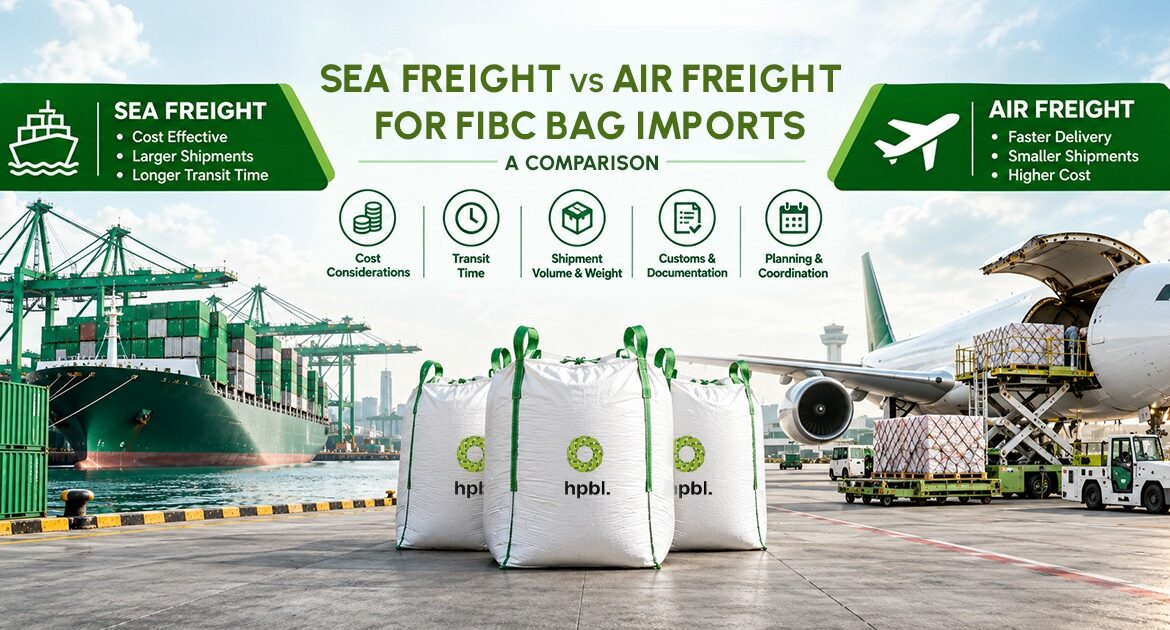
Shipping by sea and air satisfy different transportation needs. When choosing a method of shipping for their FIBC imports, buyers should compare several factors.
One of the main concerns is the cost of transportation. For larger consignments, especially where transportation costs are a concern with a large shipment, sea freight may be more suitable. Air freight is more expensive, particularly if it is heavy or takes up a lot of space.
Another important factor is transit time. It is often slower by sea freight on many international routes, but it may be faster by air freight. But the full delivery schedule also involves production, handling, customs clearance, and inland transportation.
The suitability of each option may be affected by the volume and weight of the shipment. Sea freight is often considered for larger shipments, while air freight may be more practical for smaller or urgent consignments. The final decision depends on the carrier’s limitations and the shipment’s packed dimensions.
Planning requirements also differ. Sea freight requires coordination with sailing schedules, container availability, and port operations. Air freight depends on flight availability, cargo acceptance, and airport handling procedures.
Neither method is universally suitable for every importer. Buyers should evaluate their specific shipment requirements and compare the complete transportation arrangement before making a decision.
Cost Considerations When Importing FIBC Bags
Freight charges are an important part of import planning, but they are not the only transportation cost. When comparing sea freight and air freight quotes, buyers should consider all applicable costs.
Many factors can influence the final shipping cost of FIBC bags, including shipment weight and volume, number of bags, packaging configuration, container utilization, and origin and destination.
Freight charges, handling at port or airport, customs clearance, inland transportation, cargo insurance, and storage-related costs may be other potential expenses.
Sea freight can be more cost-effective for some larger shipments, but the result depends on the route, the container arrangement, and extra handling costs. Similarly, air freight might have higher transportation charges, but faster delivery could be beneficial when delayed materials affect production or customer commitments.
A lower initial freight quotation does not necessarily result in a lower total import cost. Buyers should request a detailed quotation and confirm which services and charges are included or excluded.
Comparing total landed cost can provide a more accurate understanding of the financial impact of each shipping method.
How Delivery Time Affects Freight Selection
The planning of deliveries has to take the whole supply chain into account and not just the transportation part.
The whole process for a FIBC import might cover manufacturing, quality checks, packing, dispatch, freight transit, customs clearance, and final inland delivery. Any delays at any point can affect the expected arrival date.
The planned replenishment of inventories can use sea freight, provided that the buyer can place orders well in advance. If the buyer has an urgent requirement or wants to reduce the transportation time, air freight can be considered.
HPBL documents a normal lead time of 4–5 weeks ex-factory from receipt of a complete order. This refers to the manufacturing lead time and should not be treated as a guaranteed international delivery period. The final delivery schedule will also depend on freight selection, destination, customs procedures, and local transportation.
Buyers should communicate their required delivery date early so manufacturing and shipping arrangements can be coordinated appropriately.
When Should Buyers Choose Sea Freight or Air Freight?
The type of freight method used is based on the requirements of the order and the consequences of late delivery.
When you can use sea freight
If the order is for a larger quantity of FIBC bags and inventory requirements can be planned ahead, then sea freight can be considered. It may also be suitable for buyers who have enough time to manufacture, ship, and clear customs.
For businesses that are dealing with regular inventory replenishment, sea freight may be worth considering as part of their long-term procurement planning. However, before confirming the arrangement, you should still check shipment size, route, container availability, and total landed cost.
When Air Freight Should Be Considered
If the shipment is urgent or relatively small, air freight is an option. It may be an option when production scheduling may be affected by late materials or when a buyer has to respond to an urgent requirement.
Compare the additional transportation cost with the possible cost of late delivery. Buyers should also verify that the freight provider accepts the goods and if air transport is feasible given the weight and dimensions of the consignment.
These are general considerations, not rigid regulations. A smaller shipment may still be better transported by sea if the delivery schedule permits. An urgent shipment may not be suitable for air freight due to its weight, volume, or cost.
Important Factors to Confirm Before Shipping FIBC Bags
Before arranging international transportation, buyers should confirm the product, shipment, and delivery details with the manufacturer and logistics provider.
Important points include confirming FIBC specifications, order quantity, packed dimensions, and total shipment weight. Buyers should also verify the manufacturing completion date and clarify the agreed Incoterm, including the responsibilities of the buyer and seller.
The shipping origin and final delivery destination should be confirmed in advance. Buyers should review customs and shipping documentation requirements and check whether liners, printing, or additional components affect packaging volume.
A complete freight quotation should clearly identify applicable charges and services. Buyers should also confirm cargo insurance requirements, port or airport handling, customs clearance, and inland delivery arrangements.
Clear communication between the buyer, manufacturer, and logistics provider can help reduce avoidable delays, documentation issues, and unexpected expenses.
Planning FIBC Imports with the Manufacturer
Freight planning should begin during the procurement stage instead of waiting until the bags are ready for dispatch. Early coordination can help buyers and manufacturers align production schedules, packaging arrangements, and delivery expectations.
When placing an order, buyers should share their required delivery timeline and destination details. They should also confirm whether the shipment requires special documentation, specific packaging arrangements, or additional handling considerations.
Manufacturers such as HPBL offer customizable FIBC bag solutions for different industrial applications. Buyers can discuss product requirements and manufacturing timelines with the supplier before coordinating transportation with their logistics provider.
Clear communication is especially important when the shipment includes FIBC liners, printed bags, or other specifications that may affect packaging volume and loading arrangements. Confirming these details in advance can help reduce avoidable delays and improve shipment planning.
Freight decisions should be made according to the complete order requirements rather than relying only on transportation speed or the initial shipping quotation.
Conclusion
Sea freight and air freight provide different options for businesses importing FIBC bags internationally. Sea freight may be considered for larger, planned shipments where transportation costs and inventory planning are important. Air freight may be considered when delivery urgency or smaller shipment requirements justify the additional expense.
The right decision depends on shipment volume, weight, destination, delivery timeline, customs requirements, and total landed cost. By confirming product specifications, manufacturing schedules, freight responsibilities, and documentation in advance, buyers can make more informed transportation decisions and plan their FIBC imports more effectively.