



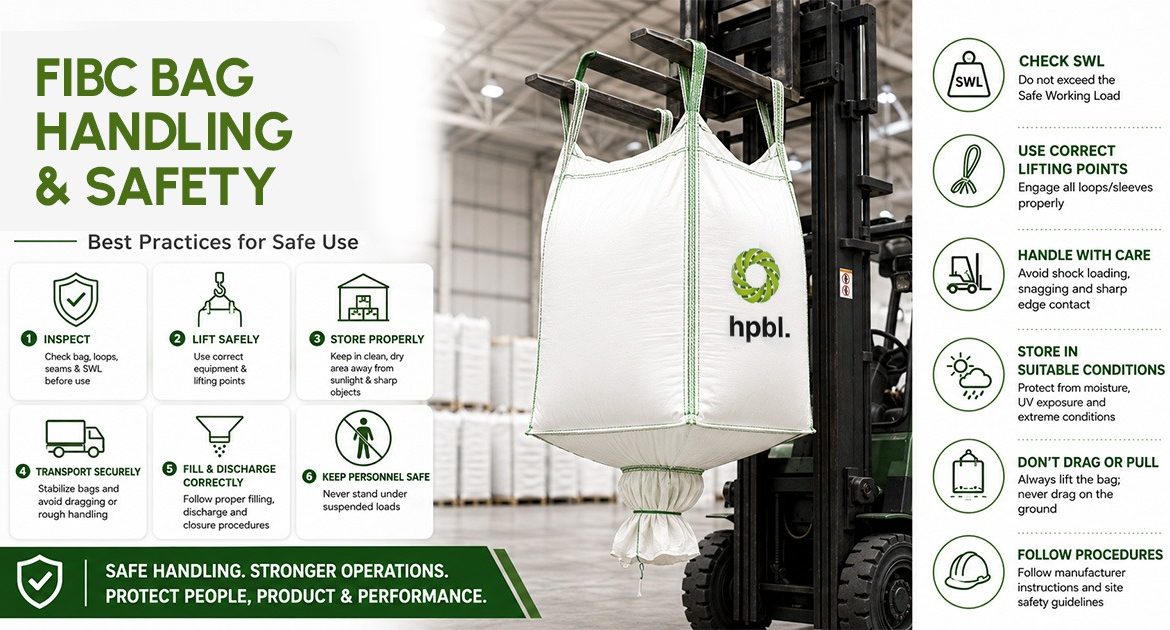
Flexible Intermediate Bulk Containers (FIBCs) are designed to store, transport, and handle substantial quantities of dry, granular, and, in some applications, slurry materials. However, getting the intended performance from an FIBC depends not only on its construction but also on how it is handled throughout its working life. Incorrect lifting, movement, storage, filling or discharge can create risks for operators and may also result in damage to the bag or loss of product containment. Safe FIBC handling therefore requires attention to the bag specification, Safe Working Load (SWL), lifting arrangement, material being handled and equipment used. This guide outlines practical considerations for inspecting, lifting, storing, transporting, filling and discharging FIBC bags while recognising that the correct procedure depends on the specific FIBC design and application.
Why Proper FIBC Handling Matters
Proper FIBC handling is closely connected with operator safety, bag integrity and efficient bulk-material movement. An FIBC is a system of components rather than simply a woven fabric container. Lifting loops or sleeves, seams, fabric, closures, filling arrangements, discharge components and, where applicable, liners all contribute to how the bag performs during use.
Handling an FIBC according to its intended design helps reduce avoidable mechanical damage and supports reliable product containment. Conversely, inappropriate lifting equipment, rough movement, sharp contact points, or unsuitable storage conditions can place unnecessary stress on the bag. The consequences can extend beyond damage to the packaging itself, particularly when a filled FIBC is being moved or suspended. For this reason, the manufacturer’s instructions and the information on the bag’s identification or safety label should form the basis of the handling procedure.
Check the FIBC Before Handling
Before an FIBC is filled, lifted, or moved, it should be checked to confirm that it is suitable for the intended task. Inspection is particularly important when a filled bag will be suspended or mechanically handled.
- Check the SWL and bag identification: Confirm the specified SWL and relevant identification information before handling the bag.
- Inspect lifting loops and lifting points: Look for signs of wear, damage, or deterioration, including around stitching and attachment areas.
- Examine the fabric and seams: Visible tears, cuts, abrasion, damaged stitching, or other defects that could affect integrity should be treated seriously.
- Check closures and filling/discharge components: Make sure spouts, closures, liners, and other components are in the condition and configuration required for use.
- Confirm material compatibility: The FIBC should be suitable for the material it is intended to contain and for the operating environment.
- Check handling equipment: Lifting and movement equipment should be appropriate for the FIBC and the filled load.
A bag should not be used simply because it appears physically capable of carrying its contents. If damage, deterioration, or a mismatch between the bag and application is identified, the FIBC should be taken out of service or assessed in accordance with the manufacturer’s instructions.
Safe Lifting and Moving of FIBC Bags
The lifting arrangement should always correspond to the FIBC’s actual construction. Different bags can use different loop, sleeve, strap, or other lifting configurations, so there is no single lifting method that applies to every FIBC. The relevant lifting loops or points should be engaged in the manner intended by the manufacturer, and the handling equipment should be compatible with that arrangement and rated appropriately for the load.
Forklifts, cranes, hoists and other equipment should be used with suitable attachments or handling devices where required. Particular attention should be paid to surfaces that may contact the lifting loops or fabric, since sharp edges, protrusions or rough surfaces can damage load-bearing components. Purpose-designed handling equipment can help avoid these contact hazards.
During movement, the FIBC should be lifted smoothly and kept stable. Sudden starts, stops, or other shock loading can place unnecessary stress on the bag and its lifting components. Filled FIBCs should not be dragged or pulled across the floor, and contact with sharp objects, corners or other surfaces capable of damaging the fabric should be avoided. Personnel should remain clear of suspended FIBCs and should never position themselves underneath a suspended load.
Safe Storage and Stacking of FIBC Bags
Storage conditions can affect both the FIBC and the material inside it. Filled and empty bags should be kept in an area appropriate for the product and packaging, with attention to the condition of the floor, surrounding surfaces, moisture, and other environmental factors. Sharp objects, protrusions, and unnecessary physical contact should be avoided because they can damage woven fabric or other components.
Stacking also needs to be considered as part of the bag’s application rather than treated as a universal procedure. Whether an FIBC can be stacked, and how it should be stacked, depends on its construction, filled weight, stability, and the manufacturer’s recommendations. Bags should not be stacked merely because sufficient floor or warehouse space is available. The stability of the complete stack and the surrounding environment should be considered before stacking filled FIBCs.
Environmental exposure is another consideration. Prolonged exposure to sunlight and UV radiation can affect some FIBC fabrics, while rain and moisture may create additional storage concerns. Where extended storage is required, appropriate protection should therefore be considered based on the FIBC specification and the conditions of the storage area.
Handling FIBCs During Transportation
FIBC bags may be moved by forklift, on a pallet where the bag and application require one, inside a warehouse, during vehicle loading or as part of containerised transportation. The appropriate method depends on the bag design and the transportation system.
Where pallets are used, they should be suitable for the FIBC and free from protrusions or other features that could damage the bag. The FIBC should also be positioned appropriately rather than being allowed to extend into areas where it may be damaged during movement.
During vehicle or container loading, consideration should be given to how the filled bags will remain stable throughout the journey. Transportation can expose FIBCs to abrasion, compression, moisture, temperature changes or sunlight depending on the route and loading environment. Appropriate positioning, protection and securing arrangements should therefore be selected for the specific transportation conditions rather than assuming that one method suits every shipment.
Safe Filling and Discharge Practices
Safe FIBC handling begins before the bag is lifted. The FIBC should first be positioned and supported in accordance with its design, and the specified SWL should not be exceeded. Filling components and closures should be used as intended, while the discharge outlet should be correctly closed before filling where the bag has a discharge spout.
The filling arrangement should provide appropriate support and stability for the particular FIBC. Once filled, the bag should remain stable during subsequent handling. The discharge system should likewise be compatible with the FIBC’s bottom construction and the equipment receiving the material. Operators should control the discharge process rather than relying on improvised methods that could place unexpected loads on the bag or expose personnel to the contents.
Product characteristics also matter. Fine powders and other materials may create dust during filling or discharge, while certain products and environments can introduce electrostatic hazards. In such situations, the FIBC’s static-protection characteristics, the material being handled, and the surrounding environment need to be considered together.
Personnel should remain clear of potentially hazardous discharge areas and should never position themselves beneath an unsupported or suspended FIBC. The specific discharge procedure should follow the bag manufacturer’s instructions and the requirements of the handling system.
Common FIBC Handling Mistakes to Avoid
Many FIBC handling problems arise from relatively simple deviations from the intended handling method. Common mistakes include:
- Exceeding the specified SWL or using the bag for a load or application for which it was not designed.
- Using damaged lifting loops, seams, or fabric instead of removing a compromised bag from service.
- Dragging or pulling filled FIBCs across floors or other surfaces.
- Using unsuitable lifting equipment or allowing lifting components to contact sharp edges.
- Allowing bags to contact sharp surfaces during storage, movement, or loading.
- Ignoring environmental conditions, such as prolonged UV exposure or moisture.
- Standing underneath a suspended FIBC, even for a short task.
- Changing the intended handling method without first checking whether the bag construction permits the alternative method.
These mistakes are avoidable when the FIBC specification, manufacturer’s instructions, and actual handling environment are considered together.
FIBC Handling Depends on the Bag Design
There is no single handling procedure that applies to every FIBC. Bags can differ in their lifting arrangements, filling systems, discharge systems, dimensions, SWLs, fabric constructions, coatings and liner configurations. These differences can influence how an FIBC should be filled, lifted, transported, stored and emptied.
For buyers and operators, this makes application information particularly important when specifying an FIBC. The manufacturer needs to understand factors such as the material being handled, required capacity, filling and discharge method, lifting arrangement, transportation conditions, and relevant environmental considerations. Providing complete application information helps ensure that the selected FIBC is appropriate for the intended handling process rather than treating the bag as a generic packaging product.
What About Different FIBC Types?
FIBC construction can also influence handling requirements where static electricity is a consideration. The commonly recognised Type A, Type B, Type C and Type D classifications distinguish FIBCs according to their static-control characteristics and intended environments.
Type A FIBCs do not provide specific static protection and are generally intended for non-flammable products and environments without relevant flammable atmospheres. Type B provides limited protection against certain types of electrostatic discharge, while Type C uses conductive elements and requires appropriate grounding during filling and emptying. Type D uses static-protective fabric and is designed to dissipate electrostatic charge without the same grounding arrangement used by Type C.
These classifications should not be treated as interchangeable handling instructions. Where flammable powders, solvents, gases or combustible dusts are involved, the FIBC type, liner, product and operating environment should be evaluated together and the applicable technical requirements followed.
HPBL and Safe FIBC Handling
HCP Plastene Bulkpack Limited (HPBL) describes its FIBCs as dimension-standardised containers used to store, transport and handle dry, granular products and/or slurry materials. Its product portfolio also includes FIBC liners for applications where additional properties such as anti-seepage, oxygen and moisture barriers, chemical resistance, anti-static performance or additional strength are required.
This range of construction options reinforces an important point about FIBC safety: the appropriate handling procedure depends on the specification of the actual bag and its application. Lifting configuration, filling and discharge requirements, material characteristics, and environmental conditions all need to be considered when selecting and using an FIBC. HPBL’s documented focus on technical parameters and quality control in its manufacturing process further highlights the importance of matching the packaging specification to the intended application.
Conclusion
Safe FIBC handling is an important part of achieving reliable bulk-material handling while protecting operators, the product, and the packaging itself. Before an FIBC is used, its condition, SWL, lifting arrangement, closures, and suitability for the intended material should be considered. During operation, appropriate lifting equipment, controlled movement, suitable storage and transportation practices, and correct filling and discharge procedures all contribute to safer handling.
Most importantly, FIBC safety should always be based on the specific bag design and application. Following the manufacturer’s instructions and considering the actual material, equipment, and working environment can help prevent avoidable handling problems and support the intended performance of the FIBC.