


Polypropylene (PP) is widely used in packaging because of its strength, durability, chemical resistance, and versatility. It is used in woven bags, films, containers, closures, and other packaging components.
For businesses supplying packaging for the US food market, however, simply identifying a package as “PP” is not enough to establish that it is suitable for food contact.
The US Food and Drug Administration (FDA) regulates substances that come into contact with food based on the substances used, their intended application, and the applicable conditions of use. Polypropylene is included in the FDA’s food-contact framework, including under 21 CFR §177.1520, but this does not mean every PP product is automatically compliant for every food-contact application.
For food packaging buyers, understanding this distinction is important when sourcing PP packaging for the US market.
How Does the US FDA Regulate Food-Contact Packaging?
The FDA uses the term Food Contact Substance (FCS) for a substance intended to be used as a component of materials that manufacture, pack, package, transport, or hold food.
Food-contact substances can include polymers, additives, colorants, coatings, adhesives, and other packaging components.
A finished package may therefore contain several substances, each of which may need an appropriate regulatory basis. Depending on the substance and application, authorization can come through regulations in Title 21 of the Code of Federal Regulations, Food Contact Substance Notifications (FCNs), or other recognized regulatory pathways.
This means food-contact compliance should be considered for the complete packaging construction, rather than only the main polymer.
What Does FDA Say About Polypropylene?
Polypropylene is specifically included in the FDA’s inventory of food-contact substances. The FDA inventory identifies polypropylene and references 21 CFR §177.1520, Olefin Polymers. This regulation provides specifications and limitations for covered olefin polymers used in food-contact applications.
However, its inclusion in the regulation should not be interpreted as blanket approval for every PP product.
The applicable requirements depend on the material, formulation, intended use, and conditions of use. A packaging buyer therefore needs to look beyond the simple statement that a product is made from polypropylene.
Why the PP Grade and Formulation Matter
A finished PP package may contain more than the base polypropylene resin.
Depending on its construction, it may include additives, processing aids, colorants, coatings, adhesives, inks, stabilizers, or liners. These additional components can affect the regulatory assessment of the finished article.
For this reason, buyers should not treat a general statement such as “FDA-approved PP” as sufficient evidence for a specific food-contact application.
What Conditions of Use Matter for PP Food Packaging?
FDA food-contact authorizations are connected to the intended conditions of use.
These can include factors such as the type of food, temperature, contact conditions, and how long the packaging is expected to remain in contact with the food.
The FDA provides food-type and condition-of-use categories for food-contact substances. These cover applications ranging from dry solids and aqueous foods to foods containing oil or fat. Conditions of use can range from refrigerated or frozen storage to room-temperature storage, hot filling, pasteurization, sterilization, and high-temperature applications.
As a result, a PP package suitable for one application should not automatically be assumed suitable for another.
For example, packaging intended for dry food stored at room temperature may have different requirements from packaging used for hot filling or high-temperature processing.
The packaging specification should therefore match the actual way the product will be used.
What Should Buyers Check Before Purchasing PP Food-Contact Packaging?
Before purchasing PP packaging for food-related applications in the US, buyers should review both the material and its intended use.
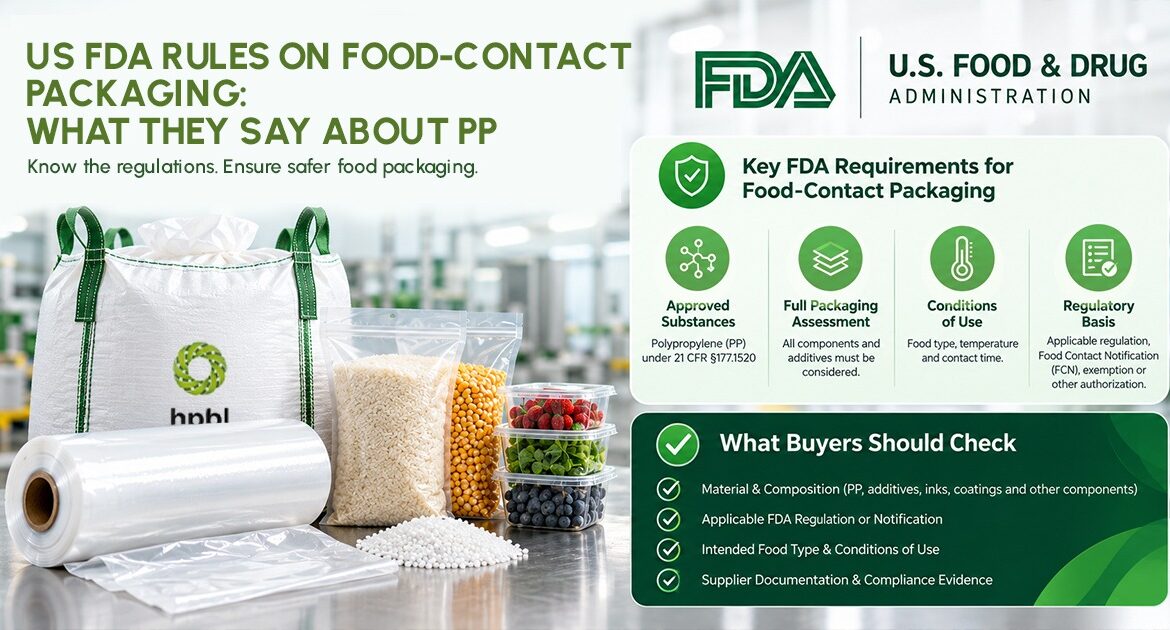
Material and Composition
Identify the materials used in the complete packaging construction.
If the package includes PP fabric, film, liner, coating, adhesive, printing ink, or other components, these should be considered as part of the overall food-contact assessment.
Regulatory Basis
Ask the supplier what FDA regulation, notification, exemption, or other regulatory basis supports the intended food-contact use.
For polypropylene, 21 CFR §177.1520 may be an important reference, but the specific requirements and limitations applicable to the material and use still need to be checked.
Intended Conditions of Use
Confirm that the packaging is intended for the actual food type and operating conditions.
Consider factors such as food type, contact temperature, contact duration, storage conditions, and any processing the package will undergo.
Supporting Documentation
Request documentation that identifies the material and supports the supplier’s food-contact compliance statement.
Depending on the application, this may include material specifications, regulatory references, declarations or letters of guaranty, and relevant testing or migration information.
The FDA notes that manufacturers may provide a letter of guaranty confirming that a product is acceptable for an intended food-contact use.
Does “Food Grade PP” Automatically Mean FDA Compliant?
No.
“Food grade” is a commonly used commercial term, but it should not be treated as a complete substitute for verifying the applicable regulatory basis.
FDA compliance depends on the individual substances present in a food-contact article and whether their use is authorized for the relevant conditions.
This is particularly important when packaging combines multiple materials.
A PP woven bag, for example, may contain a woven PP structure along with a liner, coating, lamination, adhesive, or printing system. These additional components can introduce substances that also need to be considered.
For buyers, the more useful question is not simply:
“Is this PP food grade?”
Instead, ask:
“Is this specific packaging construction supported for my intended food-contact application under US FDA requirements?”
That approach provides a more meaningful compliance review.
What About PP Woven Bags Used for Food Packaging?
PP woven packaging is used across industries, including applications involving food grains and sugar.
HPBL’s published company information states that its product portfolio includes small PP woven bags, FIBC bags, and AD Star bags, with these products used by industries including food grains and sugar.
However, use in a food-related industry does not by itself establish FDA food-contact compliance.
The complete packaging construction and intended application still need to be considered.
Woven PP Fabric vs. Complete Packaging
A woven PP bag can contain more than polypropylene fabric. Depending on the design, it may include a liner, lamination, coating, printing, adhesive, or other components.
Each relevant component can affect the regulatory assessment of the finished package.
For international buyers, this means the packaging specification should be reviewed as a complete system rather than relying only on the name of the primary resin.
Common Mistakes When Buying PP Food-Contact Packaging
Several assumptions can create problems during procurement:
- Assuming all PP is automatically FDA compliant. The polymer’s inclusion in the FDA framework does not remove the need to consider applicable specifications, limitations, and conditions of use.
- Checking only the base polymer. Additives, coatings, adhesives, inks, liners, and other components may also need an appropriate regulatory basis.
- Treating “food grade” as a complete compliance statement. The term does not by itself identify the applicable regulatory requirements or conditions of use.
- Ignoring the intended application. Food type, temperature, contact time, storage, and processing conditions can affect suitability.
- Assuming general supplier documentation covers every application. Documentation should correspond to the actual packaging construction and intended use.
- Failing to maintain compliance documentation. Material specifications and supporting regulatory documents can help with procurement, quality checks, and supplier reviews.
What US Food Packaging Buyers Should Ask Their PP Supplier
Before finalizing an order, buyers should confirm which PP material or grade is being supplied and what FDA regulation or other regulatory basis supports its intended food-contact use.
If the packaging contains a liner, coating, adhesive, ink, or another material, ask how those components are addressed. Buyers should also confirm the food type and conditions of use covered by the supplier’s documentation.
If the packaging will be exposed to hot filling, refrigeration, freezing, sterilization, or another specific process, this should be communicated before the material is selected.
Finally, request documentation that applies to the actual packaging being supplied rather than relying only on a general statement about polypropylene.
Conclusion
Polypropylene has an established place in the US FDA food-contact regulatory framework, including its coverage under 21 CFR §177.1520 for olefin polymers. However, this does not mean that every PP product or finished package is automatically suitable for every food-contact application.
For food packaging buyers, the key is to evaluate the complete packaging construction, individual components, regulatory basis, and intended conditions of use.
A practical review should therefore go beyond terms such as “FDA-approved” or “food-grade PP.” Buyers should verify the applicable regulatory basis, understand the packaging composition, confirm the intended application, and obtain supporting documentation from their supplier.