



Geotextiles play a major role in civil engineering, construction of infrastructure, and soil management. These permeable textile materials are used in applications like soil separation, filtration, drainage, reinforcement, and erosion control. However, not all geotextiles are constructed the same or perform the same.
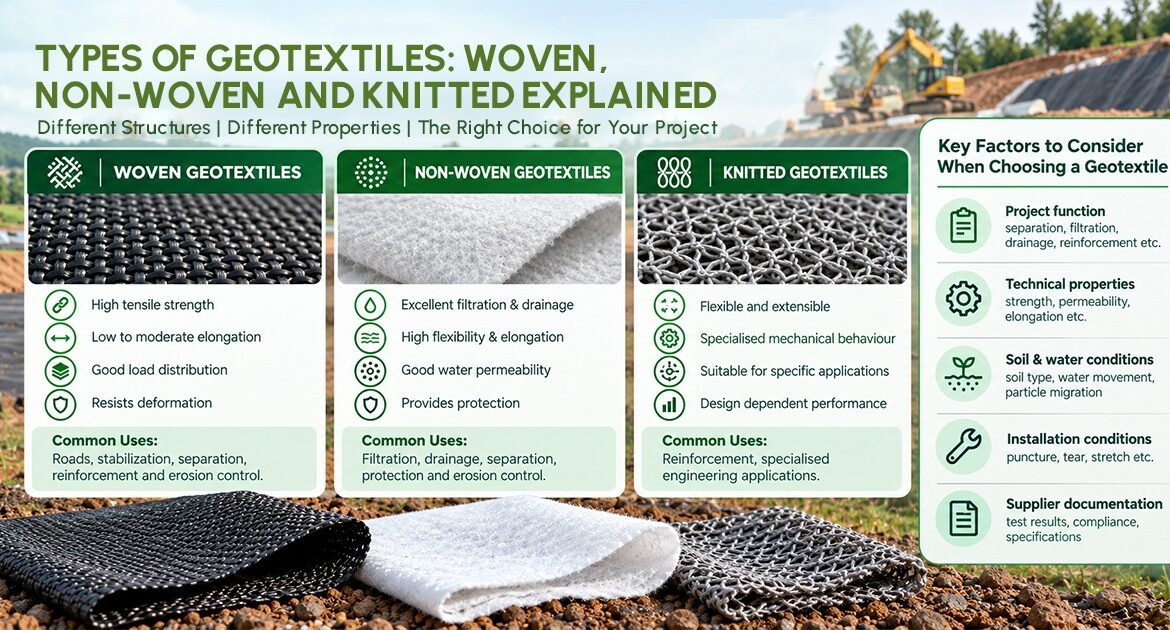
Geotextiles come in three basic types: woven, non-woven, and knitted. Each is made differently, which affects its strength, flexibility, permeability, and suitability for certain projects. Being aware of the differences can help contractors, procurement teams, and international buyers to make material selection based on real engineering needs, not just product names and generic specs.
In this guide, we discuss the manufacturing processes of various types, their common uses, and the considerations when choosing geotextiles for construction and infrastructure projects.
What Are the Main Types of Geotextiles?
Geotextiles are permeable textile materials used in contact with soil or any other geotechnical material. They are generally made from synthetic polymers such as polypropylene and polyester, although some products are made from natural fibers.
Based on the manufacturing structure, geotextiles are generally classified into three types:
- Woven geotextiles: Made by interlacing yarns, tapes, or filaments.
- Non-woven geotextiles: Fibers are bonded or mechanically entangled into a fabric.
- Knitted geotextiles: A fabric made by interlooping yarns or filaments.
The construction of each fabric determines its mechanical and hydraulic behavior. The right type needs to be selected based on the function of the project as well as soil conditions, water movement, and performance requirements.
Woven Geotextiles
Woven geotextiles are produced by weaving two or more sets of yarns, tapes, or filaments in a weaving process. The yarns are usually placed parallel to the longitudinal and transverse directions, giving a structured fabric.
This construction results in useful tensile properties and resistance to deformation for woven geotextiles, but the performance differs according to the polymer, the type of yarn, the design of the weave, and the manufacturing process.
Characteristics of Woven Geotextiles
Woven geotextiles are often specified for applications where tensile strength, separation, and soil stabilization are important. Their more structured construction can help distribute loads and restrict unwanted movement between soil layers.
However, the suitability of a woven fabric is not determined by strength alone. Buyers should also check elongation, permeability, characteristic opening size, and resistance to damage during installation.
Common Applications
Woven geotextiles can be used for:
- Highway and road construction
- Separation and stabilization of soils
- Strengthening of Selected Soil Structures
- Filtration and drainage applications based on fabric design
- Systems for erosion control
Depends on the specs of the actual product. For instance, a woven fabric designed for reinforcement may not have the same filtration properties as another woven fabric designed for water flow.
If you are an international buyer, you should review the technical data sheets and project requirements before you decide to buy a woven geotextile.
Non-Woven Geotextiles
Non-woven geotextiles are made from fibers or filaments which are laid into a web and then bonded or entangled to form a fabric. They are usually produced by needle punching, thermal bonding, and other bonding processes.
Non-woven geotextiles are not dependent on the interlacing of two sets of yarns like woven materials. The arrangement and bonding of the fibers affect properties such as thickness, flexibility, elongation, and flow of water.
Characteristics of Non-Woven Geotextiles
Non-woven geotextiles are often chosen to be used in filtration, drainage, separation and protection. Most non-woven structures are flexible and have a relatively high elongation, but the actual performance depends on the manufacturing process and product design.
Needle-punched non-wovens, for example, are produced by mechanical entanglement of fibers. Heat-bonded products use thermal processes to bind fibers.
Common Applications
Non-woven geotextiles can be used for;
- Filtration surrounding drainage systems
- Separation of soil aggregates
- Drainage Layers
- Erosion Control
- Protection of some geosynthetic systems
If a geotextile is to be used as a filter, the fabric opening size, permeability, and compatibility with the surrounding soil must be evaluated. A fabric that allows water movement may still be unsuitable if it allows too much migration of soil particles.
Knitted Geotextiles
Knitted geotextiles are made by interlooping yarns or filaments in a knitting process. The resulting fabric consists of interconnected loops instead of the interlaced yarn structure of the traditional woven geotextiles.
Knitted structures can be designed in two different ways, such as warp-knitted constructions and more specialized configurations. These designs affect the directional mechanical behavior, extensibility, and overall performance of the material.
Characteristics and Applications
Knitted geotextiles can provide useful flexibility and deformation characteristics for applications that require a specialized textile structure. However, woven and non-woven geotextiles are not commonly used in many traditional civil engineering projects.
It is contingent upon the design, the mechanical properties needed, and the application. Some knit geotextile systems are considered for reinforcement and other specialized engineering functions.
Buyers should avoid selecting a knitted geotextile solely because it offers flexibility. The fabric must meet the required strength, durability, and performance criteria for the intended project.
Woven vs Non-Woven vs Knitted Geotextiles: Key Differences
The main difference between these three kinds of geotextiles is their manufacturing structure. This structure influences the behavior of the fabric under loading, its interaction with water, and its behavior during installation and in service.
Woven geotextiles are often used when tensile strength, stabilization and reinforcement are important. The uniform arrangement of yarns can give a reasonably high stiffness and strength in a particular direction.
Non-woven geotextiles are used when there is a need for filtration, drainage, flexibility or protection. Their performance is dependent upon the fiber arrangement, the method of bonding, the thickness and other product characteristics.
Knitted geotextiles are looped yarn structures which can exhibit special mechanical behavior. Their use is more application-specific, and the suitability of any particular knitted design must be established by technical documentation.
These are general tendencies, not universal rules. A woven geotextile can be designed for filtration, while a non-woven product can have significant tensile strength. Therefore, buyers should compare actual test results instead of selecting a material based only on its category.
How to Choose the Right Geotextile
The selection of a geotextile should be based on an understanding of the engineering function and site conditions of the project. The right fabric for road stabilization may not be the right material for a drainage system or soil filtration application.
Before finalizing a product, consider the following factors:
- Main function: Identify if the geotextile is used for separation, filtration, drainage, reinforcement, or other.
- Technical Properties: Verify tensile strength, elongation, permeability, characteristic opening size, and puncture resistance as applicable.
- Soil and water conditions: Soil type, expected water movement, and probability of migration of soil particles.
- Installation Conditions: Check to see if the fabric may be subject to puncture, tearing, stretching, or other stresses related to installation.
- Supplier documentation: Request product specifications, test results, and any applicable compliance documentation before you place your order.
A geotextile should be selected according to the performance required by the project, rather than relying on weight, appearance, or material type alone. The appropriate specifications may vary according to engineering design and local standards.
Conclusion
Woven, non-woven, and knitted geotextiles differ in their manufacturing processes, fabric structures, and performance characteristics. Woven materials are commonly considered for separation and reinforcement, non-woven fabrics are frequently used for filtration, drainage, and protection, and knitted geotextiles serve more specialised applications.
However, these general categories should not replace product-specific evaluation. International buyers, contractors, and procurement teams should review technical properties, soil conditions, installation requirements, and project specifications before selecting a geotextile.