



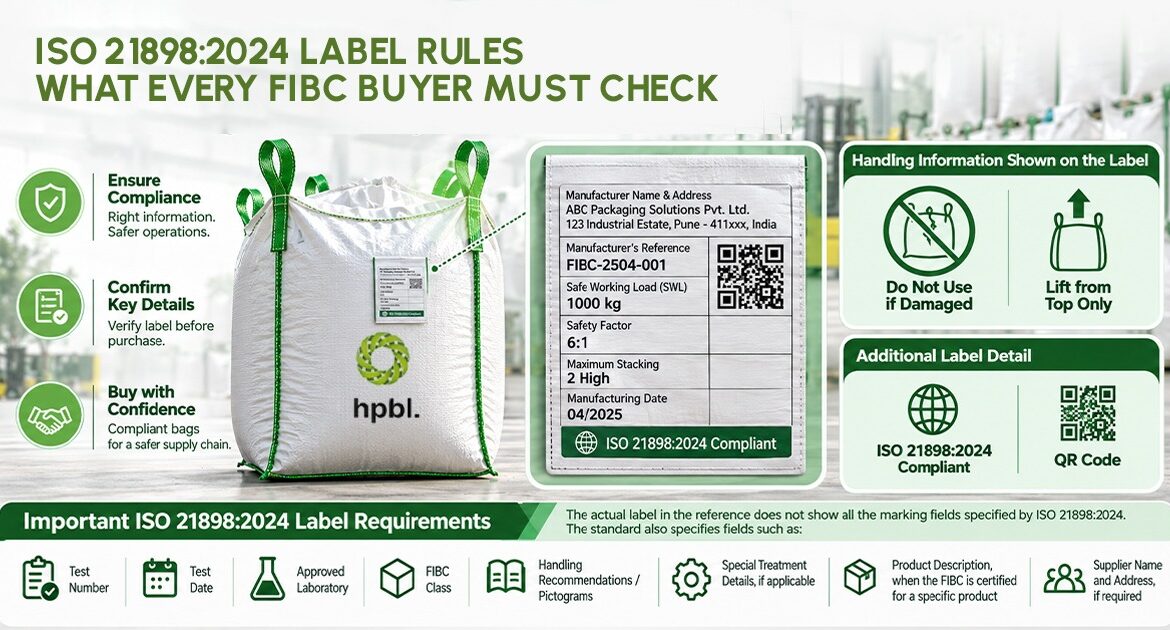
Flexible Intermediate Bulk Containers (FIBCs), commonly known as bulk bags, are used for storing, handling, and transporting many types of dry bulk materials. For buyers, checking the bag’s construction and specifications is important, but the information provided on the FIBC label is also a key part of the purchasing and verification process.
ISO 21898:2024 provides requirements for FIBCs intended for non-dangerous solid materials in powder, granular, or paste form. The standard covers materials, construction, design, type testing, marking, selection, and safe use. Published in August 2024, it is the second edition and replaces the withdrawn ISO 21898:2004.
For buyers, understanding the updated marking requirements can make it easier to check whether the information on an FIBC corresponds with the ordered specification and supporting documentation.
What Is ISO 21898:2024?
ISO 21898:2024 is an international standard for flexible intermediate bulk containers designed for non-dangerous solid materials. It applies to FIBCs intended to contain materials such as powders, granules, or pastes and designed to be lifted from above using integral or detachable lifting devices.
The standard covers more than labeling. It specifies requirements relating to FIBC materials, construction, design, type testing, and marking, while also providing guidance on selection and safe use.
This distinction is important for buyers. A label should not be considered a substitute for testing, product specifications, or appropriate manufacturing controls. Instead, the label provides important information that can be checked against the FIBC specification and relevant documentation.
ISO 21898:2004 is now withdrawn, with ISO 21898:2024 published as the current edition. Buyers reviewing older FIBC specifications or label artwork should therefore check which edition is referenced.
Why the FIBC Label Matters to Buyers
An FIBC label provides information that can help users identify the bag and understand important parameters for handling and use.
For procurement teams, the label can also provide a practical verification point. Information such as the manufacturer’s reference, Safe Working Load (SWL), safety factor, test information, FIBC class, and manufacturing date can be compared with the purchase specification and supporting documents.
The label is therefore more than a branding element. It helps connect the physical FIBC with information about its tested type and intended use.
However, buyers should avoid treating a correctly formatted label as proof that an FIBC is suitable for every application. The contents, handling conditions, required capacity, safety requirements, and other application-specific factors still need to be considered.
What Information Must Appear on an ISO 21898:2024 FIBC Label?
ISO 21898:2024 specifies information that must be included in the marking of applicable FIBCs. The standard requires the marking to be durable and easily visible and readable, either through a permanently attached label or durable printing on the FIBC body.
Manufacturer Name and Address
The manufacturer’s name and address are required on the marking.
For buyers, this provides a basic point of identification. It should correspond with the manufacturer information contained in the relevant purchasing or supplier documentation.
Manufacturer’s Reference
The manufacturer’s reference must be unique to a particular FIBC type.
This is useful when a buyer is ordering multiple FIBC designs or specifications. The reference can help connect the physical bag with the corresponding product type and technical documentation.
Safe Working Load
The Safe Working Load, or SWL, must be stated in kilograms.
SWL represents the maximum load for which the FIBC is certified for service. Buyers should check that the SWL shown on the label corresponds with the specification agreed for the order.
It should also not be confused with the weight of the empty FIBC. SWL relates to the load the bag is designed and certified to carry under the applicable requirements.
Safety Factor
ISO 21898:2024 specifies safety factors of 5:1, 6:1, or 8:1, as appropriate.
The safety factor should be checked against the purchased FIBC specification. Buyers should not assume that a higher numerical safety factor automatically means that one FIBC is more suitable for every application. The appropriate construction depends on the intended use and applicable requirements.
Maximum Permitted Stacking
The label must state the maximum number of FIBCs permitted to be stacked on the bottom FIBC.
This information is particularly relevant for warehouses and storage areas where filled bulk bags may be stacked. Buyers and users should make sure that the stated stacking information is consistent with their planned storage practices.
Test Number, Test Date, and Approved Laboratory
The marking requirements include a unique test number, the month and year in which the type test was issued, and the name of the approved laboratory.
These details are useful when buyers need to connect the FIBC with its testing and conformity documentation.
Rather than checking these details in isolation, procurement teams should use them alongside the manufacturer’s documentation when verifying an FIBC type.
ISO Standard Reference
The label must reference ISO 21898:2024.
This is an important point when reviewing older label templates. Since ISO 21898:2004 has been withdrawn and replaced by the 2024 edition, buyers should check that current documentation and applicable label artwork reference the correct edition.
FIBC Class
The standard identifies three FIBC classes:
- Heavy-duty reusable
- Standard-duty reusable
- Single-trip
The applicable class should be clearly identified on the marking.
This information is particularly important when the buyer has specific requirements concerning repeated use.
Date of Manufacture
The month and year of manufacture of the FIBC must also be included.
This gives users another piece of information for identifying the individual production period and checking the bag against relevant documentation.
Handling Recommendations and Pictograms
The marking must include handling recommendations and pictograms.
Visual instructions can be useful in international supply chains where FIBCs may be handled by people speaking different languages. Buyers should make sure the handling information is clearly visible and usable by the people responsible for lifting, moving, filling, emptying, and storing the bags.
Special Treatments and Material Details
The standard also requires details of applicable special treatments, including treatments relating to stabilization, electrostatic protection, insect repellence, and flame retardancy, as well as coated or laminated materials where applicable.
This does not mean that every FIBC needs all of these treatments. Rather, relevant treatments and material details need to be identified when they apply to the particular FIBC.
Product Description Where Applicable
Where an FIBC is certified in relation to a specific product, the description of that product is required as part of the marking.
This is particularly relevant when the FIBC specification or certification is tied to a particular type of contents. Buyers should therefore avoid assuming that an FIBC certified or tested for one product is automatically suitable for another.
Supplier Information
The supplier’s name and address can also appear on the marking where required.
Because this information is conditional, it should not be treated as a universally mandatory element in the same way as the manufacturer’s name and address.
What Has Changed From ISO 21898:2004?
One of the first things buyers should check when working with existing specifications is the edition of the standard being referenced.
ISO 21898:2004 was withdrawn in August 2024, when ISO 21898:2024 was published as the second edition.
This matters when companies continue to use older purchasing specifications, label templates, or supplier documentation. An older template should not automatically be assumed to satisfy the requirements of the current edition.
The 2024 marking requirements specify the information that must appear on the label and provide a defined example of the label layout. The standard also states that additions such as calendars or lists of SWLs and safety factors intended to be ticked are not permitted.
For buyers, reviewing the label artwork before production can therefore help identify potential issues before large quantities of FIBCs are manufactured.
How FIBC Buyers Should Check a Label Before Production
A practical review should compare the label with the purchase specification and supporting documentation.
Before approving an FIBC label, buyers should check:
- Manufacturer name and address
- Unique manufacturer reference
- SWL in kilograms
- Applicable safety factor
- Maximum permitted stacking information
- Test number and test date
- Approved laboratory
- Reference to ISO 21898:2024
- FIBC class
- Manufacturing date
- Handling recommendations and pictograms
- Applicable special treatments, coatings, or laminations
- Product description where the FIBC is certified for a specific product
This review is especially useful before production because corrections to label artwork are generally easier to address before the bags are manufactured.
Label Information vs. Actual FIBC Compliance
Checking an FIBC label is important, but it should not be treated as the complete compliance process.
The information on the label should correspond with the relevant FIBC type, specifications, and supporting test or conformity documentation. Buyers should also consider whether the physical bag matches the approved design.
For example, checking an SWL on a label is only one part of the process. The buyer also needs to ensure that the ordered bag has the appropriate construction and is intended for the required application.
ISO 21898:2024 itself covers materials, construction, design, type testing, and marking, which demonstrates why label information should be considered as one part of a broader FIBC evaluation.
In practical terms, buyers should avoid selecting an FIBC solely because its label contains the expected information.
ISO 21898:2024 and FIBC Reuse
The FIBC class shown on the label also has practical implications for reuse.
ISO 21898:2024 distinguishes between heavy-duty reusable, standard-duty reusable, and single-trip FIBCs. The standard states that an FIBC documented and marked as a single-trip FIBC in conformity with the standard shall not be reused. It also specifies that reusable FIBCs conforming to the document are to be reused only with the same type of contents as in the first use.
This is an important point for buyers because the term “reusable” should not be interpreted as unrestricted reuse.
A buyer considering repeated use should evaluate the FIBC class, its intended application, condition, handling requirements, and the applicable manufacturer’s guidance.
Conclusion
ISO 21898:2024 gives FIBC buyers a structured basis for checking important information about bags intended for non-dangerous goods. The marking requirements cover manufacturer identification, SWL, safety factor, stacking information, testing details, FIBC class, manufacturing date, handling information, and other applicable details.
For buyers, the key is not simply to check whether a label is present. The information on the label should be compared with the purchase specification and supporting documentation, while the physical FIBC should also be evaluated for its intended application.