


Timely supply of packaging is an important part of the production and logistics plan for companies that regularly use FIBC bags. Delays in the receipt of bulk bags can impact filling schedules, warehouse operations, product dispatch, and overall supply chain efficiency.
However, FIBC bag lead times are not standard across the board. The time needed may differ depending on the bag design, quantity, customization, liner requirements, testing, and production planning required.
Being aware of these factors can help buyers plan their orders more effectively and avoid unnecessary delays.
What Is FIBC Bag Lead Time?
FIBC bag lead time generally refers to the period from order confirmation to completion of all bags for dispatch. This can include specification checks, production scheduling, manufacturing, quality control, and any required testing or preparation depending on the order.
A repeat order with a specification that already exists may require fewer decisions than a new FIBC design. In the same way, a conventional construction may require less co-ordination than a bag with tailor-made dimensions, special filling or discharge arrangements, coating, or an internal liner.
Thus, instead of assuming a standard lead time, buyers should discuss the expected production schedule with the manufacturer before placing an order.
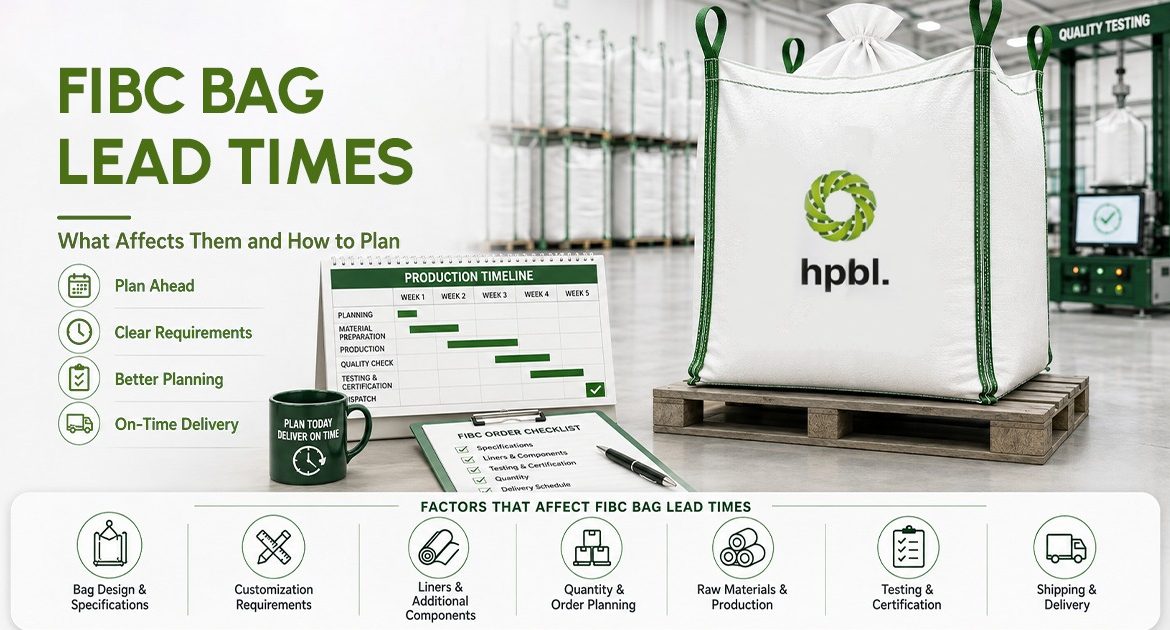
What Factors Affect FIBC Bag Lead Times?
Several factors can influence how quickly an FIBC order can be manufactured.
Bag Design and Specifications
One of the first things to consider is the bag’s design. Before starting production, the dimensions, Safe Working Load (SWL), fabric construction, lifting arrangement, filling system, discharge system, and other specifications need to be determined.
Clear requirements are a good start to production planning with less uncertainty. Changes to specifications after the order has entered production can create additional coordination and could impact the schedule.
Customization Requirements
Customized FIBC bags might require more planning than established constructions.
Confirm custom sizes, printing, special lifting arrangements, filling or discharge arrangements, coatings, and other application-specific features prior to manufacturing.
The more specific the requirement, the more important it is to lock down the technical specifications in advance.
FIBC Liners and Additional Components
Some applications require an internal liner for additional product protection or other performance properties. Adding a liner adds a further element to be matched to the FIBC construction and application.
HPBL’s documented product portfolio includes FIBC liners designed for applications requiring properties such as anti-seepage, moisture barrier, oxygen barrier, chemical resistance, anti-static performance, and strength.
If a liner or any other additional component is needed, it should be defined in the specification up front and not after the production planning has started.
Quantity and Order Planning
Production planning may also be dependent on the quantity ordered. Large volume requirements shall be scheduled in accordance with the manufacturer’s production capacity and current commitments.
Existing customers may already have specifications and production requirements, while a new order may require more technical discussion before production can commence.
For businesses with regular FIBC consumption, forecasting requirements and communicating expected quantities in advance can make procurement planning easier.
Raw Materials and Production Conditions
FIBC manufacturing involves several stages and materials, including woven polypropylene fabric and components such as lifting loops, seams, closures, and liners where applicable.
The availability of the required materials and the production schedule can therefore influence the time required to complete an order.
Rather than assuming a fixed manufacturing period, buyers should confirm the expected schedule with the manufacturer based on the specific order.
Standard vs. Customized FIBC Orders
FIBC orders are not all at the same level of readiness.
A repeat order against an established specification is usually easier to plan as the bag construction, dimensions, materials, and other requirements are already defined.
New or custom orders may involve additional discussions on dimensions, SWL, filling and discharge arrangements, coating, printing, liners, and other application requirements.
This does not mean that all customized orders will have a certain or predictable extra lead time. The real schedule is determined by the requirements and production conditions of the order.
Why Clear Specifications Can Help Reduce Delays
One of the simplest ways to better FIBC order planning is to set the specifications before starting production.
Buyers should clearly state the intended application and discuss the technical requirements directly with the manufacturer.
The important details may include the product to be packed, bag dimensions, SWL, lift configuration, filling and discharge arrangement, coating, liner requirements, printing, quantity, and any applicable testing or certification requirements.
Further coordination effort and impact on the planned schedule may result from modifications after production planning.
Open communication, therefore, benefits both the buyer and manufacturer by reducing uncertainty and helping to ensure that the finished FIBC meets the intended application.
How Testing and Certification Can Affect Lead Time
When planning an order for FIBCs, testing and certification requirements should also be taken into account.
Not all FIBCs require the same tests or certifications. Requirements are determined by the intended use, product, handling conditions, and applicable regulations.
For example, some FIBCs used for the transport of dangerous goods will require UN certification and associated performance testing. These requirements should be established prior to production so that the necessary specifications and test arrangements can be included on the order.
Additional testing may also be required for specific customer or application requirements.
Planning these requirements early avoids testing or certification being an afterthought.
How to Plan FIBC Orders Around Your Production Schedule
If you use FIBC bags on a regular basis, you can plan your requirements before the current stock reaches a critical level.
A practical way to do this is to forecast the likely consumption, confirm the specifications, calculate the quantity required, discuss the production schedule with the manufacturer, and allow sufficient time for quality checks and any applicable testing before dispatch.
Buyers should also think about their own receiving and storage facilities. Even if the manufacturing is finished on schedule, delays in coordinating the next step in the supply chain can affect when the bags are actually available for use.
“Open communication with the manufacturer about upcoming orders can help make procurement more predictable for recurring requirements.
What Buyers Should Ask Their FIBC Supplier
Buyers should ensure that key details have been discussed and agreed before confirming an order.
Some questions to ask are:
- Are all the FIBC specifications finalized?
- Is this a standard, repeat, or custom build?
- Are there any liner or coating requirements?
- Are there any specific testing or certification requirements?
- Amount confirmed as needed?
- What data are still required before production can begin?
- When will production and shipping be?
These questions can help identify potential problems before the manufacturing process starts.
Planning FIBC Orders With HPBL
An FIBC manufacturer’s understanding of the application and technical requirements is an important part of developing the appropriate packaging solution.
HPBL’s product portfolio covers FIBC bags and FIBC liners for industrial bulk-handling applications. FIBCs for the storage, transport, and handling of dry granular and/or slurry materials are described in the company’s documentation, and its liner range offers further options for applications requiring specific protection or performance characteristics.
When working on a FIBC requirement, it is helpful to discuss the product, application, bag construction, and required features with the manufacturer to establish a more realistic production plan.
Buyers should not assume a generic lead time, but rather should verify the expected schedule for their specific order, taking into account its specifications, quantity, customization, and any testing requirements that apply.
Planning Ahead Makes FIBC Procurement More Reliable
There are many factors that can affect FIBC lead times, from bag specifications and customization to quantity, liners, testing, and production scheduling.
Your best bet is to outline your requirements early, communicate them clearly, and establish the production schedule you expect before you place the order with the manufacturer.
For companies that regularly use FIBC bags in their normal business operations, forward planning can help reduce the pressure of last-minute buying and help maintain a steady flow of packaging supply