


When evaluating an FIBC supplier for food-related applications, buyers may come across certifications such as BRCGS Packaging Materials and FSSC 22000. Both are internationally recognised food-safety-related certification schemes, but they are structured differently and place emphasis on different aspects of packaging operations.
For FIBC manufacturers, understanding the difference is important because a certification for a food safety management system does not automatically establish that every FIBC produced by a supplier meets a particular product specification or food-contact requirement.
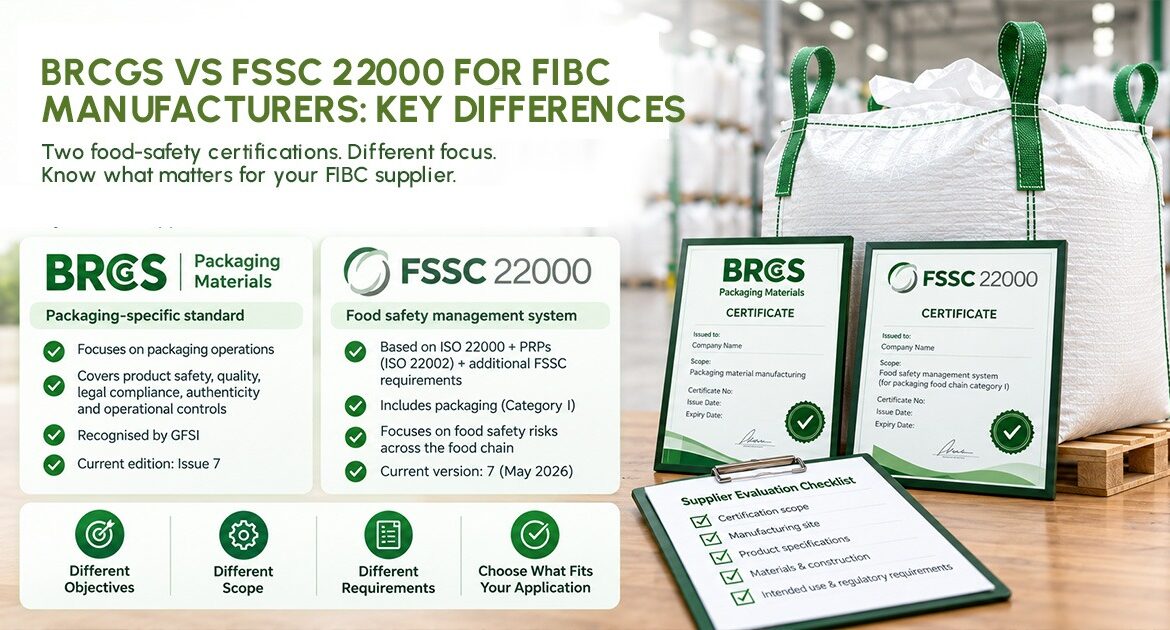
BRCGS Packaging Materials is specifically designed for packaging manufacturers and covers product safety, quality, legal compliance, authenticity, and operational controls. FSSC 22000, on the other hand, is a food safety management system certification scheme built around ISO 22000, sector-specific prerequisite programmes, and additional FSSC requirements.
For international buyers, comparing the two can help determine which certification is more relevant to the supplier, application, and procurement requirements.
What Are BRCGS Packaging Materials and FSSC 22000?
BRCGS Packaging Materials is a packaging-specific standard developed for sites that manufacture, process, or supply packaging materials. The current edition is Issue 7. BRCGS states that the standard is used not only by food packaging producers but also by producers of packaging for other applications across the supply chain. It is recognised by the Global Food Safety Initiative (GFSI).
The standard is intended to help a site demonstrate that its products are quality assured, legally compliant, authentic, and produced under appropriate operational controls. Its requirements therefore relate directly to packaging operations rather than only to a general food safety management system.
FSSC 22000 has a different structure. It is a certification scheme for food safety management systems. FSSC 22000 Version 7 is based on ISO 22000:2018, relevant prerequisite programmes from the ISO 22002 series, and additional FSSC requirements. The current Version 7 was published in May 2026.
In simple terms, BRCGS Packaging Materials is a packaging-specific certification standard, while FSSC 22000 is a food safety management system certification scheme that includes packaging within its scope.
What Does BRCGS Packaging Materials Mean for an FIBC Manufacturer?
For an FIBC manufacturer, BRCGS Packaging Materials can provide a framework specifically focused on the production of packaging materials. For buyers evaluating FIBC bags, this packaging-specific approach simplifies supplier vetting by ensuring strict quality control, hygiene, and safety protocols are maintained throughout production.
Its requirements address areas such as product safety, quality, legal compliance, authenticity, hazard analysis, risk assessment, operational controls, and continual improvement. Issue 7 also strengthened areas including product safety culture and hazard analysis and risk assessment.
This packaging-specific focus can be particularly relevant when an FIBC supplier manufactures packaging intended for food-related applications.
BRCGS certification does not mean that every FIBC manufactured by the company is automatically suitable for every food-contact application. Buyers still need to review the certificate scope, manufacturing site, product specifications, materials, intended use, and any applicable regulatory requirements.
For example, an FIBC may be manufactured using polypropylene, but the complete construction could also involve liners, coatings, printing inks, adhesives, or other components. The buyer should therefore assess the actual packaging configuration rather than relying solely on the supplier’s BRCGS certification.
What Does FSSC 22000 Mean for an FIBC Manufacturer?
FSSC 22000 focuses on establishing and maintaining a food safety management system.
The scheme uses ISO 22000 as its core, together with relevant prerequisite programmes and additional FSSC requirements. For packaging manufacturers, FSSC 22000 includes Category I, which covers the production of food packaging and packaging materials.
Under Version 7, the packaging category is built around ISO 22000, the relevant ISO 22002 prerequisite programme requirements, and additional FSSC requirements. This creates a structured system for managing food safety risks within the activities covered by the certification.
For an FIBC supplier, this can be relevant where the packaging is intended for use in the food industry. However, buyers should check the exact certification scope. FSSC certificates identify the applicable food-chain category and the activities covered by the certification.
As with BRCGS, FSSC 22000 certification should not be treated as automatic proof that a particular FIBC meets every product-specific food-contact or regulatory requirement.
BRCGS vs FSSC 22000: What Is the Difference for FIBC Buyers?
The main difference is the way each certification approaches packaging and food safety.
BRCGS Packaging Materials is specifically designed around packaging operations. It addresses product safety, quality, legality, authenticity, and operational requirements for packaging materials. This makes it directly relevant when a buyer wants to evaluate a packaging manufacturer’s controls.
FSSC 22000 is centred on the food safety management system. For packaging manufacturers, its Category I scope covers the production of food packaging and packaging materials, using ISO 22000 together with relevant prerequisite programmes and additional FSSC requirements.
For an FIBC buyer, neither certification should automatically be considered “better.” Their relevance depends on the buyer’s requirements, the supplier’s activities, the intended use of the packaging, and any customer or market requirements.
A food packaging buyer may therefore encounter suppliers with BRCGS certification, FSSC 22000 certification, or potentially both. The important question is whether the certification covers the relevant manufacturing site and packaging activity.
Does an FIBC Manufacturer Need Both BRCGS and FSSC 22000?
There is no universal requirement for every FIBC manufacturer to hold both certifications.
The appropriate certification can depend on the markets served, customer specifications, product applications, manufacturing activities, and requirements imposed by retailers, food manufacturers, or other customers.
BRCGS Packaging Materials is applicable to packaging producers across the supply chain and is not limited exclusively to food packaging. FSSC 22000 Category I, in contrast, specifically addresses the production of food packaging and packaging materials.
A supplier may therefore choose or be required to maintain one certification based on its customers and market requirements, while another supplier may maintain both.
For buyers, the more useful approach is not simply to ask whether a supplier has a recognised certification. The buyer should determine what the certification covers and whether it corresponds to the FIBC being purchased and its intended application.
What Should FIBC Buyers Check on the Certificate?
When reviewing BRCGS or FSSC 22000 certification from an FIBC supplier, buyers should examine the certificate and its scope rather than relying only on the certification name.
Check:
- Legal company name: Confirm that the certificate belongs to the supplier or manufacturing entity involved in producing the FIBCs.
- Manufacturing location: Verify that the factory producing the packaging is included within the certified site or scope.
- Certification standard and version: Identify whether the document refers to BRCGS Packaging Materials Issue 7 or the applicable FSSC 22000 scheme version.
- Certification scope: Check the activities, packaging materials, and operations covered by the certificate.
- Certificate status and dates: Confirm that the certification is current.
- Certification body: Check who issued the certificate and whether it is an appropriate certification body for the relevant scheme.
- Product relevance: Confirm that the certification relates to the manufacturing activity and packaging application being evaluated.
BRCGS directs companies seeking certification to use a BRCGS registered Certification Body, while FSSC 22000 certification is conducted through licensed Certification Bodies under the FSSC scheme.
What Other Documents Should Buyers Request?
BRCGS or FSSC 22000 certification should be considered one part of supplier evaluation rather than the only evidence needed to approve an FIBC for a particular application.
Depending on the intended use, buyers may also need product specifications, material information, food-contact documentation, relevant test reports, declarations, and other regulatory or customer-specific documentation.
This is particularly important for FIBCs used with food products or ingredients. A certification may demonstrate that a supplier operates a recognised management or packaging safety system, but it does not necessarily answer every product-specific regulatory question.
Buyers should also review the complete FIBC construction. If the bag contains a liner, coating, laminate, adhesive, printing system, or other component, these should be considered when evaluating the packaging’s suitability for the intended food-contact application.
The supplier’s documentation should therefore match the actual packaging being purchased, the materials used, the intended contents, and the conditions under which the FIBC will be handled and used.
Conclusion
BRCGS Packaging Materials and FSSC 22000 can both be relevant when evaluating an FIBC manufacturer for food-related applications, but they approach food safety and packaging assurance differently.
BRCGS Packaging Materials is specifically focused on packaging operations and addresses areas including product safety, quality, legal compliance, authenticity, and operational controls. FSSC 22000 is a food safety management system certification scheme based on ISO 22000, relevant prerequisite programmes, and additional FSSC requirements.
For FIBC buyers, neither certification should automatically be treated as proof that every product manufactured by a supplier is suitable for every food-contact application.
The most useful approach is to review the certification standard and version, certification scope, manufacturing site, current status, and certification body, then compare these details with the specific FIBC requirements.
For food-related FIBC applications, buyers should also obtain product-specific material and compliance documentation. Evaluating both the supplier’s certification and the actual packaging construction provides a more complete basis for supplier qualification and product selection.