


When sourcing Flexible Intermediate Bulk Containers (FIBCs) internationally, certifications and test documents are often part of the supplier qualification process. Buyers may receive ISO certificates, product certifications, laboratory test reports, declarations, or other compliance documents before placing an order.
However, receiving a certificate does not automatically mean that it is current, relevant, or applicable to the FIBCs being purchased.
A certificate can belong to a different legal entity, cover another manufacturing site, have an unsuitable scope, or no longer be valid. Buyers therefore need to verify the document rather than relying only on its appearance or the supplier’s description.
The verification process should establish who is certified, who issued the certificate, what it covers, whether it is current, and whether it applies to the FIBC and application being considered.
What Does a Valid FIBC Certification Actually Mean?
Certification and testing documents can serve different purposes, so they should not be treated as interchangeable.
A management-system certification demonstrates that an organization has been assessed against the requirements of a particular management-system standard. ISO 9001, for example, concerns quality management systems. It does not automatically certify that every FIBC manufactured by the company complies with a specific product standard.
A product certification addresses specified requirements for a product, while a test report records the results of particular tests performed on a product or sample. A supplier declaration is another type of document and may represent the supplier’s own statement regarding compliance.
This distinction is important when evaluating an FIBC supplier. A manufacturer may have a valid ISO 9001 certificate while still needing separate product-specific testing or documentation for a particular FIBC application.
The first question should therefore be: What exactly does this document certify or demonstrate?
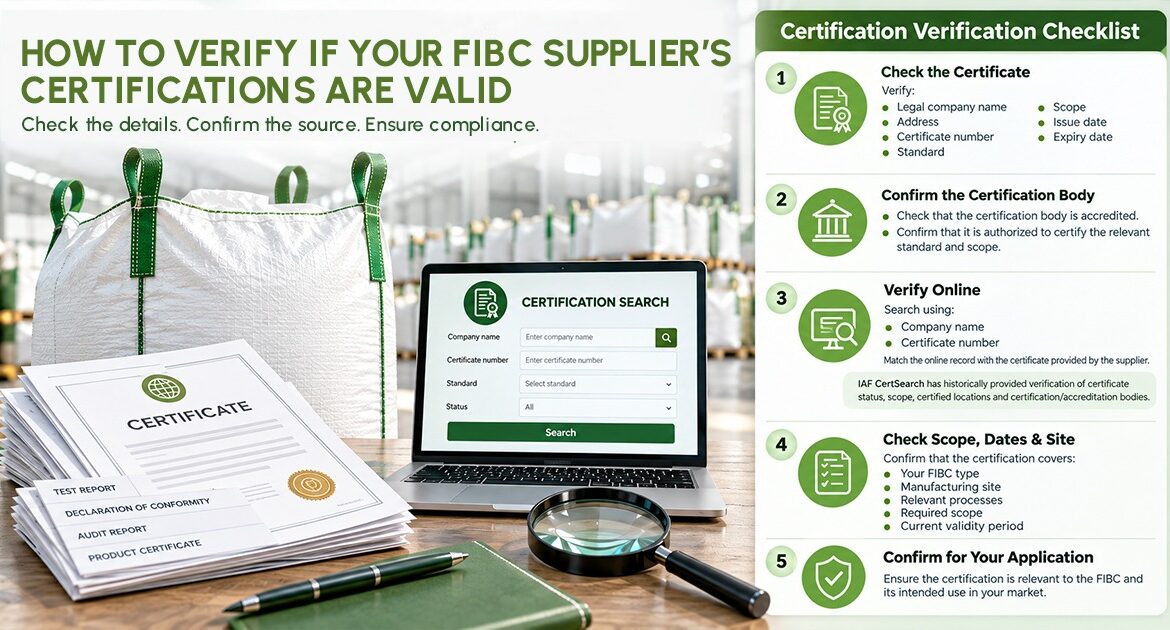
Check the Certificate and Certification Body
Start by examining the certificate itself.
Check the legal name of the certified organization and compare it with the company you are purchasing from. If the supplier operates through a trading company while the certificate names a separate manufacturer, the relationship between the entities should be clear.
The manufacturing address should also be checked. A supplier operating several factories may have certification covering only one particular site.
Also record the certificate number, standard referenced, certification scope, issue date, and expiry or current-status information where applicable.
The next step is to identify the certification body, which is the organization that issued the certificate.
ISO itself does not issue certificates or certify companies. Certification is performed by independent certification bodies. ISO recommends checking whether a certification body is accredited and provides IAF CertSearch as one way to verify accredited certification.
Accreditation is separate from certification. An accreditation body assesses the competence of certification bodies against relevant requirements. For buyers, this distinction helps determine whether an accredited certification has been issued within an appropriate conformity-assessment framework.
Verify the Certificate Online
Once the certificate details are available, try to verify them independently.
For accredited management-system certifications, IAF CertSearch provides a global database for checking accredited certification status. ISO states that the database brings together information from accreditation bodies and certification bodies and can be used to verify accredited certifications.
Search using the certified company’s name or certificate information and compare the result with the document supplied by the FIBC manufacturer.
Pay attention to details such as the certified entity, certificate number, standard, certification body, status, and dates. The information should be consistent with the certificate you received.
If the certificate cannot be located, this does not automatically prove that it is invalid. Some documents or certification schemes may not be represented in a particular database. In such cases, check the relevant certification body or accreditation body directly.
IAF guidance recommends referring first to the certification body named on the certificate when confirming the validity of an accredited certification.
If you need to contact the certification body, obtain its contact information independently from its official website rather than relying only on contact details printed on a questionable document.
Check the Certification Scope, Dates and Manufacturing Site
A certificate can be genuine and current but still not cover what you are purchasing.
The scope is therefore one of the most important parts to review.
Check whether the certification covers the relevant manufacturing activity, location, processes, and applicable standard. If the certificate covers a company’s management system but does not identify the specific product, this should not be interpreted as product certification.
Dates also need attention. Check the certification or issue date, expiry date where applicable, and current status. Depending on the certification scheme, surveillance or recertification activities may also affect the current status.
The manufacturing location should be checked at the same time. If an FIBC supplier has factories in different countries or cities, confirm that the site producing your bags is covered by the documentation being provided.
These checks are especially useful when a supplier has changed its company structure, added a new factory, or uses separate manufacturing and trading entities.
Does the Certification Actually Apply to the FIBC You Are Buying?
This is where certification verification needs to be connected to the actual product.
A supplier having a valid management-system certificate does not automatically establish that every FIBC bag it produces meets the requirements of a particular FIBC standard.
For example, ISO 21898:2024 is an FIBC-specific standard covering materials, construction, design, type testing, marking, selection, and safe use for FIBCs intended for non-dangerous solid materials in powder, granular, or paste form.
If an FIBC supplier refers to this standard, buyers should check the relevant product documentation and testing information rather than assuming that an ISO 9001 certificate proves compliance with ISO 21898:2024.
The same principle applies to specialized applications. Depending on the product and intended use, buyers may need additional documentation relating to food-contact requirements, dangerous-goods applications, testing, or customer-specific specifications.
The key is to match the documentation to the actual FIBC design, intended contents, handling conditions, and applicable requirements.
Common Red Flags in FIBC Certifications
Several inconsistencies should prompt additional verification:
- The certificate has expired. An old certificate should not be treated as evidence of current certification status.
- The company name does not match. Differences between the supplier, manufacturer, and certified legal entity should be explained.
- The factory address is different. Certification for one manufacturing site should not automatically be assumed to cover another.
- The certificate number cannot be independently verified. Check the issuing certification body or relevant certification database.
- The certification body cannot be verified. Buyers should be able to establish who issued the certificate and, where relevant, its accreditation status.
- The scope does not match the supplier’s activity. A valid certificate with an unrelated scope may have limited relevance to the purchase.
- A management-system certificate is presented as product certification. ISO 9001 or another management-system certification does not automatically establish compliance of a specific FIBC with a product standard.
A single discrepancy does not necessarily prove that a certificate is fraudulent. It should, however, lead to further verification before the document is relied upon.
What Should FIBC Buyers Ask Their Supplier?
Before approving an FIBC supplier, buyers can ask for the current certification and confirm:
- What legal entity and manufacturing site does the certificate cover?
- What is the certificate number and current status?
- Who issued the certificate?
- Is the certification body appropriately accredited for the relevant certification activity?
- What exactly is included in the certification scope?
- Where can the certificate be independently verified?
- Does the documentation relate to the FIBC product being purchased?
- Are relevant product test reports or compliance documents available for the intended application?
Certification should be treated as one part of supplier qualification rather than the only quality check. Buyers may also review product specifications, samples, testing, manufacturing controls, traceability, and previous supply performance.
Conclusion
Verifying an FIBC supplier’s certifications involves more than checking whether a document looks genuine. Buyers should establish who is certified, who issued the certificate, what the certification covers, whether it is current, which manufacturing site is included, and whether the documentation applies to the FIBC being purchased.
It is also important to distinguish management-system certification from product-specific compliance. A valid ISO certificate can provide useful information about a supplier’s certified management system, but it does not automatically prove that every FIBC meets a particular product standard.
For international FIBC buyers, independently verifying certification documents before supplier approval provides a more reliable basis for evaluating supplier documentation and matching it to the requirements of the intended application.