


Bulk materials are moved every day across industries such as agriculture, chemicals, food processing, construction, and mining. While Flexible Intermediate Bulk Containers (FIBCs) are designed to handle large quantities of materials efficiently, their performance depends heavily on safety standards.
A bulk bag that is not properly designed, tested, or certified can pose risks during lifting, storage, transportation, and handling. That’s why manufacturers and buyers pay close attention to things like Safe Working Load (SWL), safety factors, testing procedures, and certifications.
Understanding these standards helps companies choose the right FIBC bag for their needs, minimising risk and keeping operations running smoothly.
What Are FIBC Bag Safety Standards?
FIBC bag safety standards are guidelines and requirements to make sure that bulk bags perform safely under expected conditions of use.
These standards cover a variety of subjects from bag design, manufacture, testing, and use. They are designed to ensure that a bag can safely carry its intended load and not fail during handling or transportation.
Safety standards are especially important when bags are used for heavy materials, hazardous substances, or products that require strict quality control.
Established standards enable manufacturers to provide greater consistency and users to be more assured of the reliability of the packaging solution.
Understanding Safe Working Load (SWL) in FIBC Bags
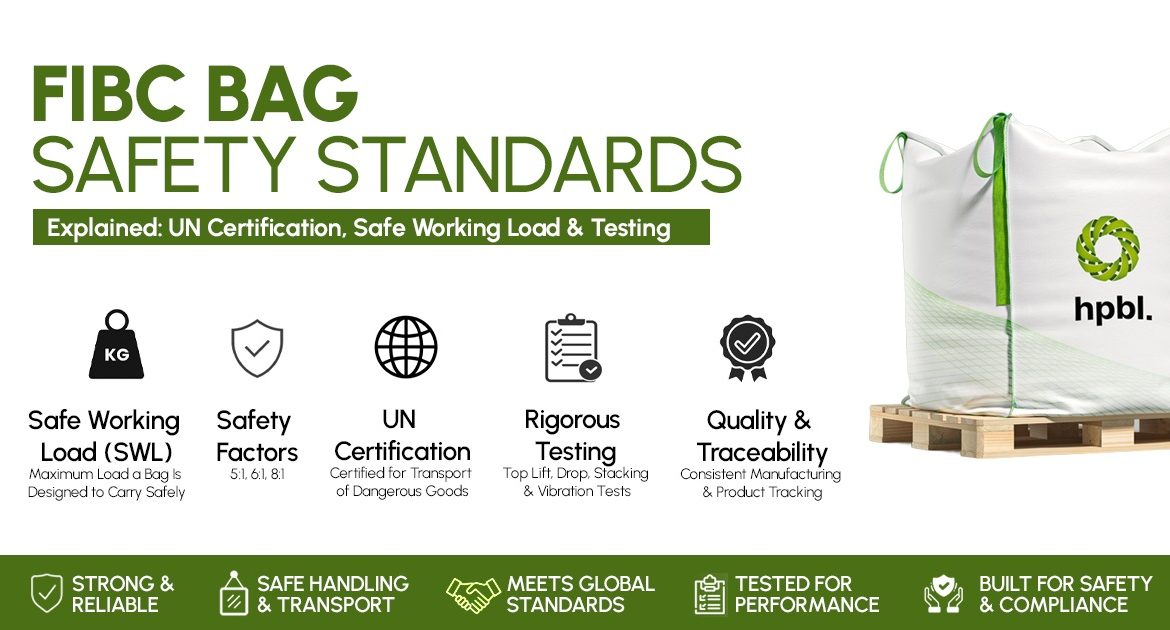
One of the most important specifications on any FIBC bag is the Safe Working Load or SWL.
SWL is the maximum weight a bag is designed to carry safely under normal operating conditions. This value is determined at the design and testing stage.
For example, if a bag has a SWL of 1,000 kg, this means that in normal use the bag should not be loaded above that weight.
The correct SWL must be selected. Overloading a bag can put too much stress on the lifting loops, seams, or fabric of the bag, and can result in failure.
In deciding on the appropriate load capacity, you should take into account the weight of the product, the way you handle it, the way you store it, and the way you transport it.
Understanding SWL helps businesses improve safety while maximizing the performance of their bulk packaging operations.
What Do FIBC Safety Factors Mean (5:1, 6:1, and 8:1)?
FIBC bags are also given a safety factor in addition to SWL.
The safety factor is the ratio between the tested breaking load and the Safe Working Load (SWL). It provides an additional margin of safety to account for real-world handling conditions.
For single-trip bags, a 5:1 safety factor is typically used. Single-trip bags are designed for one filling and one discharge cycle under controlled conditions.
In multi-trip applications where the bag is used more than once under controlled conditions, a safety factor of 6:1 is usually applied.
For some specialized applications, an 8:1 safety factor may be needed to provide an even higher level of security.
For example, a bag with a Safe Working Load of 1,000 kg and a safety factor of 5:1 must be able to withstand 5,000 kg during testing before failure occurs.
Knowing safety factors helps users choose bags that are suitable for their handling needs while still maintaining appropriate safety margins.
What Is UN Certification for FIBC Bags?
Some products have greater standards to be met in terms of the packaging, particularly in the case of hazardous materials being shipped.
And this is where UN-certified FIBC bags come in.
UN-certified FIBC bags are tested and approved in accordance with applicable dangerous goods transportation regulations. Depending on the mode of transport and destination, these may include the UN Recommendations on the Transport of Dangerous Goods, ADR (road transport), IMDG Code (sea transport), and RID (rail transport).
These bags are often used for chemicals, industrial powders, and other regulated materials that need extra protection during transportation.
Many FIBCs are also manufactured and tested in accordance with ISO 21898, an internationally recognized standard that specifies requirements and testing methods for flexible intermediate bulk containers.
Clear markings are also required in the certification process to identify the classification of the bag and its approved use.
Properly certified packaging can help support regulatory compliance and reduce transportation risks for companies engaged in international logistics.
Key Tests Used to Verify FIBC Bag Safety
The test is the only way to know if a FIBC bag can actually perform safely in the real world.
There are a number of bag performance tests that are widely used and accepted by the industry.
Top Lift Test
This test verifies the strength of the lifting loops and the overall structure of the bag under the rated load.
Drop Test
Controlled drops are used to evaluate the bag’s ability to withstand impact during handling and transportation.
Stacking Test
This test measures the bag’s ability to support loads when stacked during storage and transport.
Tear Test
The tear test evaluates the resistance of the fabric and construction to tearing under load.
Righting Test
This test assesses the bag’s ability to withstand stresses that may occur when a filled bag is tipped and returned to an upright position.
Additional tests, such as vibration testing, may be conducted depending on customer requirements and transportation conditions.
Why Traceability and Quality Control Matter
Safety is not just about testing the end product. Just as important are consistent manufacturing processes.
Quality control starts from the selection of raw materials and goes through weaving, cutting, stitching, and final inspection.
Many manufacturers use documented procedures to monitor the quality of production and to assure consistency from batch to batch.
“Traceability is an extra layer of confidence.” Individual bags or production runs can be linked to specific production records, including lot numbers, production dates, operator records, raw material batch traceability, and testing records. This improves transparency and makes it easier to investigate quality or compliance requirements when needed.
This is especially useful when working in regulated industries or large supply chains where documentation and accountability are key.
Quality control helps to minimize variability and leads to long-term product reliability.
How to Choose a Safe and Compliant FIBC Bag
Choosing the right FIBC bag is more than just size.
First, companies need to consider what kind of material they’re storing or transporting. Different bag specifications may be required for fine powders, food ingredients, chemicals, and agricultural products.
The load capacity is another important factor. The selected bag shall have a suitable Safe Working Load and the correct safety factor for the intended use.
Transportation regulations may require UN certification if hazardous materials are involved.
Consider storage conditions, too. The best bag design may depend on moisture exposure, UV exposure, stacking requirements, and transportation methods.
It can make the selection process much easier to work with experienced manufacturers. HPBL offers FIBC bag solutions that are designed to meet various industrial needs while maintaining quality and safety standards.
Conclusion
FIBC bag safety standards help to make sure bulk materials can be stored, handled, and transported safely. Knowledge of Safe Working Load, safety factors, UN certification, and testing requirements helps businesses choose packaging solutions that fit their operational and regulatory requirements.
Selecting the right FIBC bags that are tested and compliant can help companies mitigate risk, improve efficiency, and ensure consistent performance across the supply chain.