



Agricultural businesses often need to store, handle, and transport large quantities of materials efficiently. Grains, fertilisers, seeds, and other dry bulk products can require packaging that provides sufficient strength while also making storage and transportation easier.
FIBC bags are widely used for bulk material handling because they can hold substantial quantities of product while remaining practical to handle and transport. Among the different FIBC constructions available, baffle FIBC bags are designed to retain a more defined shape when filled.
This can make them useful in applications where storage space, stacking, transportation, and handling efficiency are important. However, a baffle FIBC is not automatically the right choice for every agricultural product. The appropriate construction depends on the material, required capacity, handling method, and storage and transportation conditions.
What Are Baffle FIBC Bags?
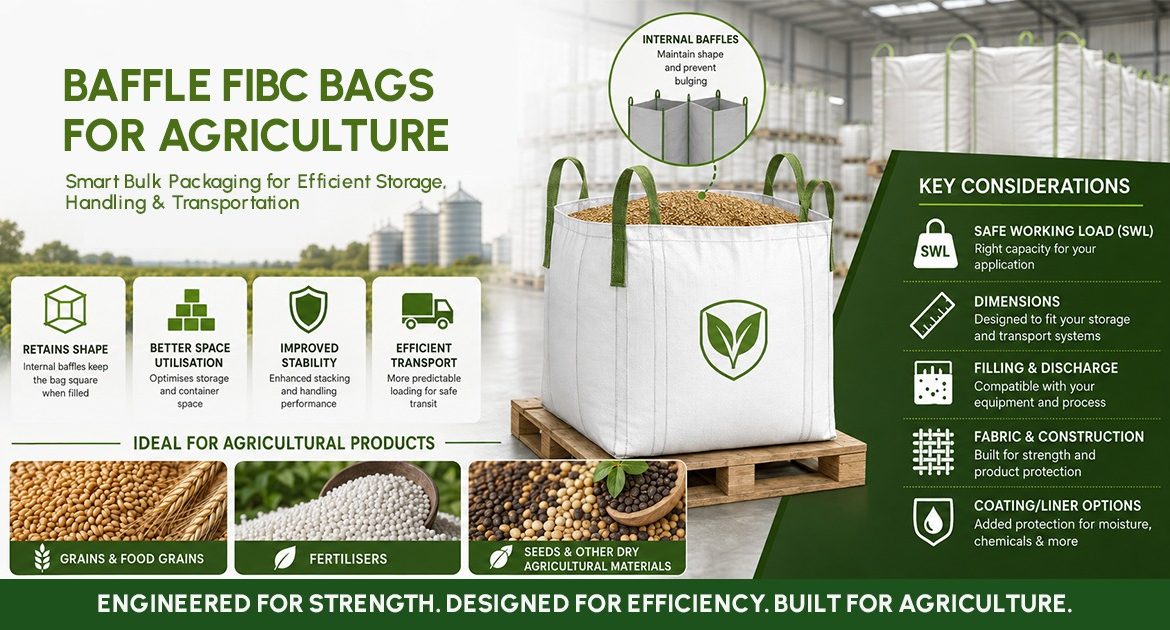
Baffle FIBC bags are bulk bags that incorporate internal fabric panels, commonly known as baffles, between the sides of the bag. These internal panels help limit the outward expansion of the bag when it is filled.
A conventional FIBC can become wider and more rounded as material is added. A baffle construction helps the bag maintain a more defined shape, which can make the filled bag easier to organise in certain storage and transportation environments.
The basic purpose of the baffle is therefore not simply to increase the bag’s strength. It is primarily related to maintaining the shape and dimensions of the filled FIBC.
The final performance of a baffle FIBC depends on its overall construction, including the fabric, seams, lifting configuration, dimensions, and other components. These features need to be selected according to the intended application rather than treating the baffle as a standalone feature.
Why Are Baffle FIBCs Useful for Agricultural Applications?
Agricultural supply chains frequently involve the movement of bulk quantities of materials between farms, processing facilities, warehouses, distributors, and other locations. Packaging that supports efficient handling and storage can therefore be valuable.
One practical advantage of baffle FIBCs is their ability to maintain a more consistent shape after filling. This can make it easier to arrange filled bags in warehouses and other storage areas.
The more defined shape may also help businesses make better use of available space in certain storage and transportation arrangements. When multiple filled bags need to be positioned together, maintaining a predictable shape can make organisation easier.
Baffle FIBCs can also be considered where handling equipment and transportation systems benefit from a more structured bag shape. However, the actual benefit depends on the bag design and the operating conditions.
For agricultural businesses, the decision should therefore be based on the complete packaging requirement rather than choosing a baffle construction simply because it offers better shape retention.
Agricultural Materials That Can Be Packed in Baffle FIBCs
FIBCs are used across agricultural and related industries for handling a range of dry bulk materials. HPBL’s published information identifies food grains and fertilisers among the industries and applications associated with its FIBC products.
Grains and Food Grains
Grains and other agricultural commodities are often handled in substantial quantities. FIBCs can provide a practical way to package, store, and transport these materials.
For such applications, businesses need to consider the product’s characteristics, required bag capacity, filling process, storage conditions, and transportation requirements. Where shape retention is useful for the intended storage or logistics arrangement, a baffle FIBC may be considered.
Fertilisers
Fertilisers are another important bulk agricultural material. Depending on the product, the packaging may need to withstand substantial loads and provide appropriate protection during storage and transportation.
The selection of fabric construction, capacity, filling and discharge configuration, and any additional protection should be based on the characteristics of the specific fertiliser being packed.
Seeds and Other Dry Agricultural Materials
Seeds and other dry agricultural products can also require bulk packaging for transportation and storage. Product sensitivity, cleanliness requirements, moisture exposure, and handling conditions should be considered when determining the appropriate FIBC construction.
A baffle design may be useful where maintaining a defined shape is an operational priority, but it should still be matched to the requirements of the particular product.
How Baffle Design Supports Storage and Transportation
The main operational benefit of a baffle FIBC is its ability to retain a more controlled shape when filled.
This can be useful in warehouses where filled bags need to be arranged efficiently. A more structured shape can make the bags easier to position and organise compared with a conventional FIBC that expands more freely after filling.
Transportation is another area where shape can matter. When bulk bags are loaded into vehicles or containers, available space needs to be used effectively. A more predictable filled shape may help with arranging multiple bags within the available space.
However, space utilisation should not be considered independently from safety and handling requirements. The bag must still be designed for its intended Safe Working Load, lifting method, filling system, discharge system, and storage conditions.
The objective is to select a construction that supports the complete operation rather than focusing on one feature in isolation.
Important Features to Consider When Choosing a Baffle FIBC
Before selecting a baffle FIBC for agricultural use, buyers should establish the basic technical requirements of the application.
- Safe Working Load (SWL): The bag should have an appropriate load capacity for the intended filling weight and handling conditions.
- Dimensions: The dimensions should work with the available storage, transportation, and handling arrangements.
- Filling arrangement: The filling system should be compatible with the equipment and process being used.
- Discharge arrangement: The outlet configuration should support how the agricultural material will be removed from the bag.
- Fabric and construction: The fabric and overall construction should be selected according to the product and expected handling conditions.
- Coating or liner requirements: Additional protection may be considered where the material or environment requires it.
These factors should be considered together. A bag with the correct capacity but an unsuitable discharge system, for example, may not work efficiently within the intended operation.
Baffle FIBC Bags vs Conventional FIBC Bags
Both baffle and conventional FIBCs can be suitable for agricultural bulk packaging, but their construction provides different practical characteristics.
A conventional FIBC may be sufficient when the application does not require a more controlled filled shape. It can provide a practical solution for storing and transporting bulk materials where available storage and handling arrangements accommodate the natural shape of the filled bag.
A baffle FIBC may be considered where shape retention and space utilisation are more important. The internal baffles help control the outward expansion of the bag, giving it a more defined form.
The right choice therefore depends on the application. Agricultural businesses should consider the product, required capacity, available space, handling equipment, and transportation method before deciding between the two constructions.
When Should Agricultural Businesses Consider a Baffle FIBC?
Baffle FIBCs can be particularly worth considering when businesses need to organise large quantities of filled bags in a relatively controlled storage arrangement.
They may also be useful when warehouse space is limited or when transportation arrangements benefit from a more predictable bag shape. Operations that use mechanical handling equipment can also consider whether the selected construction works effectively with their existing systems.
However, a conventional FIBC may be perfectly suitable when shape retention is not a major requirement.
The decision should ultimately be based on how the bag will be filled, lifted, stored, transported, and discharged. Understanding these requirements before ordering helps ensure that the selected construction provides a practical solution rather than adding features that are unnecessary for the application.
Choosing the Right Baffle FIBC for the Application
Selecting a baffle FIBC begins with understanding the agricultural material being packaged.
Product density, particle characteristics, moisture sensitivity, required filling weight, storage conditions, and transportation method can all influence the final specification. The filling and discharge systems also need to be considered because the bag must work with the equipment used in the operation.
Storage conditions are equally important. If bags are expected to remain in storage for extended periods or are exposed to particular environmental conditions, the packaging specification may need to account for those circumstances.
The required SWL and dimensions should then be established along with the lifting configuration and any coating or liner requirements.
Rather than selecting a standard baffle bag without considering the application, buyers should communicate these requirements to the manufacturer. This allows the bag construction to be evaluated as a complete packaging solution.
Baffle FIBC Solutions from HPBL
HPBL’s FIBC portfolio supports bulk-material handling applications across industries, including applications associated with food grains and fertilisers. The company’s documented product information covers FIBCs for storing, transporting, and handling dry granular and/or slurry materials.
For agricultural applications, the appropriate FIBC specification depends on the material and the way the bag will be used. Factors such as capacity, dimensions, lifting arrangement, filling and discharge requirements, and product protection should therefore be discussed before finalising the packaging.
Where additional product protection is required, HPBL’s documented FIBC liner range includes options designed for properties such as anti-seepage, moisture barrier, oxygen barrier, chemical resistance, anti-static performance, and strength, depending on the application.
The focus should remain on matching the packaging construction to the actual requirements of the agricultural operation rather than assuming that one FIBC design is suitable for every product.
Conclusion
Baffle FIBC bags can provide practical advantages for agricultural bulk handling where maintaining a more defined filled shape is important. This can support better organisation, storage, and transportation of materials such as grains, fertilisers, and other suitable dry bulk products.
However, the baffle construction is only one part of the packaging specification. SWL, dimensions, fabric construction, filling and discharge arrangements, handling methods, and product characteristics all need to be considered before selecting the final bag.
For agricultural businesses, the most reliable approach is to start with the material and operating requirements and then select an FIBC construction that fits those needs. This helps ensure that the packaging supports efficient handling and storage without adding features that are unnecessary for the application.