


Flexible Intermediate Bulk Containers (FIBCs), also known as bulk bags or jumbo bags, are widely used for storing, handling, and transporting dry granular products and, depending on the design, slurry materials. FIBCs are available in different constructions to accommodate varying material, handling, storage, and transportation requirements.
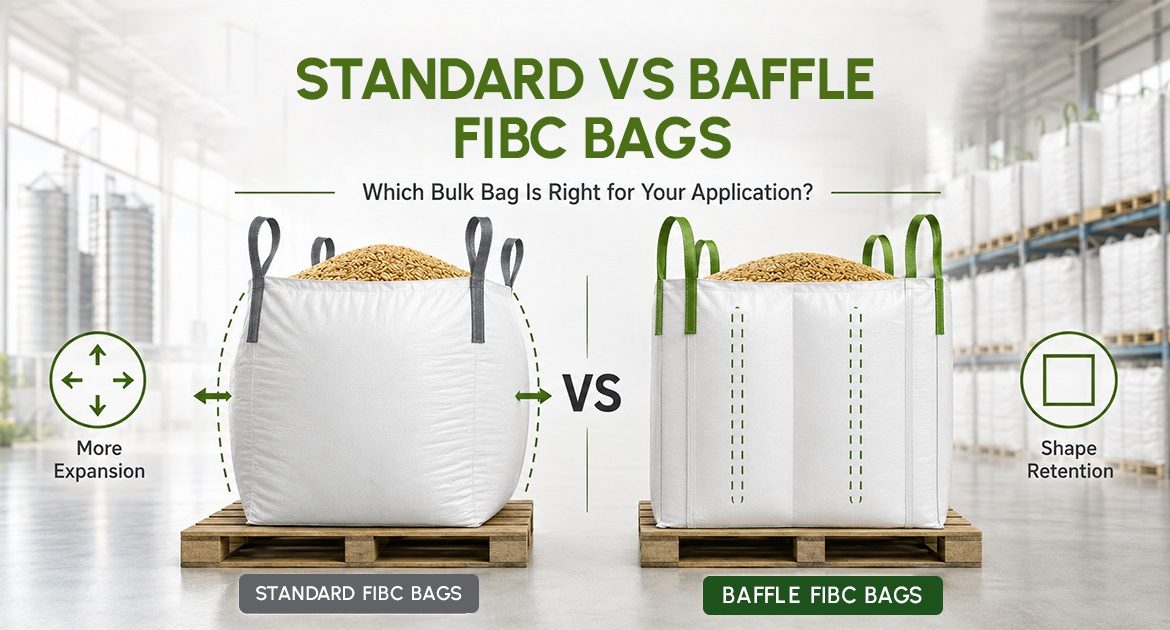
Standard and baffle FIBCs are two commonly considered constructions. Although they can look similar from the outside, they behave differently when filled. A standard FIBC generally allows more natural outward expansion, while a baffle FIBC uses internal fabric panels to control this expansion and retain a more defined shape.
So, which construction is right for your application? The answer depends on your operational requirements. Neither standard nor baffle FIBCs are universally better. The right choice depends on how the bag will be filled, handled, stored, and transported.
What Is a Standard FIBC Bag?
A standard FIBC uses a conventional flexible woven fabric construction designed to contain and transport bulk materials. The body is typically formed from flexible fabric panels that are assembled and sewn together, with suitable lifting loops and filling and discharge arrangements based on the intended application.
When the bag is filled, the flexible fabric naturally expands outward as the material occupies the available internal volume. The final filled shape can therefore be less defined and may vary depending on the material, filling level, and bag design.
This conventional construction can be suitable for many bulk material applications where the available storage and transportation space can accommodate the bag’s natural filled shape. It can also be appropriate where precise shape retention is not a major operational requirement.
However, choosing a standard FIBC still requires careful consideration. Dimensions, Safe Working Load (SWL), lifting configuration, filling arrangement, and discharge arrangement should be selected according to the material and handling process.
What Is a Baffle FIBC Bag?
A baffle FIBC incorporates internal fabric panels known as baffles. These panels connect supporting sections of the bag body and help restrict how far the sides can move outward when the FIBC is filled.
As a result, a baffle FIBC generally retains a more defined shape after filling than a conventional FIBC. The controlled profile can make the filled bag more predictable in situations where available storage or transportation space has a defined footprint.
The primary purpose of baffles is shape retention and improved control of the bag’s geometry. They are not simply intended to make the FIBC stronger. The overall performance and safe working capability of an FIBC depend on its complete design, including the fabric, seams, lifting arrangement, dimensions, and intended handling conditions.
Baffle construction may therefore be useful where a more structured filled shape is an important part of the storage, transportation, or handling process.
Standard vs Baffle FIBC Bags: Key Differences
The most noticeable difference between standard and baffle FIBCs is their filled shape. A standard FIBC generally has greater freedom to expand outward, resulting in a more naturally flexible profile. A baffle FIBC restricts this outward movement and generally maintains a more controlled shape.
This difference can influence space utilisation. A standard bag may be suitable when sufficient space is available around the filled FIBC, and there is no requirement for a consistent footprint. In contrast, a baffle FIBC may be useful where bags need to fit within defined storage areas or where available transportation space needs to be used efficiently.
Storage arrangements can also influence the choice. The more predictable profile of a baffle FIBC may support organised warehouse positioning and stacking arrangements. However, the practical benefit depends on the complete bag design and storage conditions.
Transportation requirements should also be considered. Where bags are loaded into defined spaces, a controlled shape may be useful. However, this does not mean that a baffle construction is automatically the better choice.
The application should determine the construction. Material characteristics, dimensions, SWL, filling and discharge systems, storage configuration, and transportation method should all be evaluated together.
When Is a Standard FIBC a Better Choice?
A conventional FIBC can be an appropriate choice when the available storage space can accommodate the bag’s natural filled shape and precise shape retention is not an important operational requirement.
For example, if bags are stored with sufficient clearance around them, the additional shape control provided by a baffle construction may not be necessary. Similarly, if the material and handling process do not require a structured bag profile, a standard FIBC can meet the application’s requirements.
Standard construction can therefore be suitable for businesses looking for a conventional FIBC design that matches their material handling process.
The important consideration is not whether standard construction is generally better, but whether it satisfies the specific application. Required capacity, SWL, dimensions, lifting configuration, filling method, and discharge arrangement should all be established before finalising the specification.
When Should You Consider a Baffle FIBC?
A baffle FIBC may be worth considering when shape retention and space utilisation are important operational requirements.
For applications with limited storage space, a more controlled filled profile may help make better use of the available area. The defined shape may also be useful for organised warehouse storage where bags need to be positioned within specific areas.
Transportation arrangements can be another consideration. Where FIBCs are loaded onto pallets, into containers, or into other defined spaces, controlling outward expansion may help with positioning and space utilisation.
Baffle construction may also be useful in handling systems where a more predictable bag shape is beneficial.
However, these advantages depend on the complete FIBC design, the material being handled, filling conditions, and the intended storage and transportation arrangements. A baffle FIBC should therefore be considered when its shape retention characteristics address a specific application requirement.
Factors to Consider Before Choosing Between Standard and Baffle FIBCs
- Product characteristics: Consider density, particle size, flow behaviour and other material properties that may influence how the product fills the bag.
- Required capacity and SWL: Match the FIBC to the intended filling weight and required Safe Working Load.
- Storage space: Evaluate the warehouse layout, available floor space and planned storage or stacking arrangement.
- Transportation method: Consider how the bags will be loaded, positioned, moved and transported.
- Filling and discharge system: Ensure the selected FIBC construction and opening arrangements are compatible with the existing equipment and process.
- Protection requirements: Consider whether a coating or liner is required to provide additional protection for the material.
These factors should be assessed together rather than independently. A bag that meets the required capacity may still be unsuitable if its construction does not work with the filling system, storage arrangement, or transportation method. Discussing the complete application with the manufacturer can help ensure that the final FIBC specification is appropriate for the intended use.
Do Baffle FIBCs Always Save More Space?
Not necessarily. Baffles are designed to control the shape of a filled FIBC, and this can improve space utilisation in suitable applications.
However, the actual amount of space used depends on several factors. These can include the bag dimensions, filling level, product characteristics, storage configuration and handling conditions.
For this reason, buyers should not assume that every baffle FIBC will provide the same space-saving benefit. A fixed percentage of space savings should not be claimed without application-specific evidence.
The best approach is to assess how the FIBC will actually be stored and transported and then determine whether the controlled shape provided by baffles offers a meaningful practical benefit.
What About Liners and Coatings?
The choice between standard and baffle construction is only one part of FIBC selection. Some applications may also require additional protection for the material being stored or transported.
HPBL’s published product information states that its FIBC liners can provide properties including anti-seepage, oxygen barrier, moisture barrier, chemical resistance, anti-static performance, and strength. These properties can be relevant where the material requires additional protection during storage or transportation.
The appropriate liner should be selected according to the characteristics of the material and the protection required for the application. Coatings and liners should therefore be considered alongside the FIBC construction rather than as separate decisions.
For applications where product protection is important, buyers can also evaluate the differences between FIBC coatings and liners as part of the overall packaging selection process.
Choosing the Right FIBC for Your Application
Choosing between a standard and baffle FIBC should start with the application rather than with a preference for one construction.
First, understand the material being handled and determine the required filling weight, capacity, and SWL. Next, review the filling and discharge requirements to ensure that the FIBC will work with the existing handling equipment.
Storage and transportation conditions should then be evaluated. Consider the available space, warehouse arrangement, pallet or container requirements, and how the filled bags will be moved.
The next step is to determine whether shape retention is actually important. If natural outward expansion is acceptable, a standard FIBC may be suitable. If a more controlled profile is needed for storage or transportation, a baffle FIBC may be worth considering.
Finally, evaluate whether coatings or liners are required for additional product protection. The complete FIBC specification should then be discussed and finalised with the manufacturer.
HPBL’s FIBC Packaging Approach
HPBL’s published product basket identifies FIBC bags and FIBC liners as product categories. Its published information describes FIBCs for storing, transporting and handling dry granular and/or slurry materials.
HPBL’s documented liner capabilities include properties such as anti-seepage, oxygen barrier, moisture barrier, chemical resistance, anti-static performance, and strength. These capabilities can be considered where the material requires additional protection as part of the packaging solution.
For buyers, the key consideration is application-specific selection. Material characteristics, required capacity, handling methods, storage conditions, transportation requirements, and protection needs can all influence the appropriate FIBC specification.
Rather than selecting a construction based solely on its appearance or a general assumption about performance, buyers should discuss the complete application with the manufacturer to determine the appropriate bag design and features.
Conclusion
Standard and baffle FIBCs serve different operational requirements. Standard FIBCs can be suitable where natural bag expansion is acceptable and precise shape retention is not a major concern.
Baffle FIBCs may be advantageous where a more controlled filled shape and improved space utilisation are important. However, the benefits depend on the complete bag design and the application in which it will be used.
The correct choice depends on the material, required capacity and SWL, storage conditions, transportation method, filling and discharge requirements, and product protection needs. Buyers should consider these factors together and discuss the complete application with the manufacturer before finalising the FIBC specification.