


FIBC bags are widely used for the storage, handling, and transportation of bulk materials in many different sectors, including agriculture, chemicals, food processing, construction, and manufacturing. During their use, these bags may be occasionally exposed to sunlight, especially during outdoor storage, transportation, loading, or temporary handling.
Although polypropylene is a durable material, prolonged exposure to ultraviolet (UV) radiation can gradually degrade its performance. The degree of this degradation is dependent on several factors, including exposure time, intensity of sunlight, environmental conditions, and the construction of the FIBC.
Understanding the impact of sunlight on FIBC bags can assist businesses in selecting appropriate packaging, managing storage conditions, and minimizing unnecessary exposure.
How Sun Exposure Affects FIBC Bags
FIBC bags are usually made of woven polypropylene, chosen for its strength, flexibility, and relatively low weight. Prolonged exposure to ultraviolet radiation, however, will slowly degrade polypropylene.
Over time, UV exposure can affect the structure of the material. As degradation proceeds, some of the original mechanical properties of the fabric may be lost. This can affect the strength and durability required to handle and transport bulk materials.
The effects are not necessarily immediate. A brief exposure to sunlight may not affect the bag significantly, but repeated or prolonged exposure may have a greater effect.
For this reason, companies that anticipate their FIBC bags to be exposed to the elements for long periods of time should consider the anticipated exposure conditions when selecting the bag construction.
Why UV Exposure Can Reduce Polypropylene Performance
Ultraviolet radiation provides energy that causes some polymers to undergo chemical changes. Polypropylene is sensitive to UV degradation processes that can influence the polymer chains in the material during long-term exposure to UV.
With further degradation, the fabric becomes increasingly less resistant to mechanical stress. Exposure can lead to changes depending on the severity of the exposure, such as reduced tensile performance, increased brittleness, or fabric degradation.
At different rates, this may happen. The rate of degradation is dependent on the intensity of sunlight, geographic location, exposure duration, temperature, and other environmental factors.
That is why it is not possible to set a fixed outdoor lifespan for all FIBC bags. The actual performance depends on the bag’s construction and the conditions in which it is stored and used.
Which FIBC Bags Are More Exposed to Sunlight?
Some applications are simply more exposed to sunlight than others.
FIBCs are subject to increased UV exposure when:
- Stored outdoors before or after filling
- Temporarily located in open loading/unloading areas
- Transported in direct sunlight
- Used in outdoor handling operations in agriculture
- Stored in buildings with open sides, doors or other openings that allow direct sunlight to enter
The expected exposure in these cases shall be taken into account in the selection of packaging.
If stored indoors, artwork is usually better protected from direct UV radiation, but the actual conditions of storage are also important. Bags should be stored away from direct sunlight unnecessarily to prevent avoidable degradation.
What Is UV Stabilization in FIBC Bags?
UV stabilization is a method of increasing the resistance of polypropylene fabric to ultraviolet radiation-induced degradation.
UV stabilizers can be added to the polypropylene material during manufacturing. They help to reduce the effects of UV exposure and can improve the ability of the fabric to retain its properties when used in environments where exposure to sunlight is expected.
This can be especially useful for FIBCs that may be stored or manipulated in outdoor environments.
UV stabilization, however, does not make a FIBC forever resistant to sunlight. This is done to increase resistance to degradation due to UV, not to eliminate it.
The amount of UV protection you need depends on what you plan to use it for and the conditions you anticipate it will be exposed to.
When Should You Consider UV-Stabilized FIBC Bags?
If a FIBC is likely to be exposed to a lot of sunlight during its intended use, then UV-stabilized fabric may be worth considering.
For instance, applications could be found in long-haul transport, agricultural use, outdoor storage, or temporary storage in exposed areas.
The decision should be made based on what conditions are going to be, rather than just if the bag will see sunlight at some point. Occasional exposure and long-term outdoor exposure have different requirements.
Businesses should consider the likely length of time the bags will be exposed, whether they will be full or empty during exposure, and the environmental conditions at the storage or handling location.
Talking through these factors with the FIBC manufacturer can help determine whether UV stabilization should be included in the bag specification.
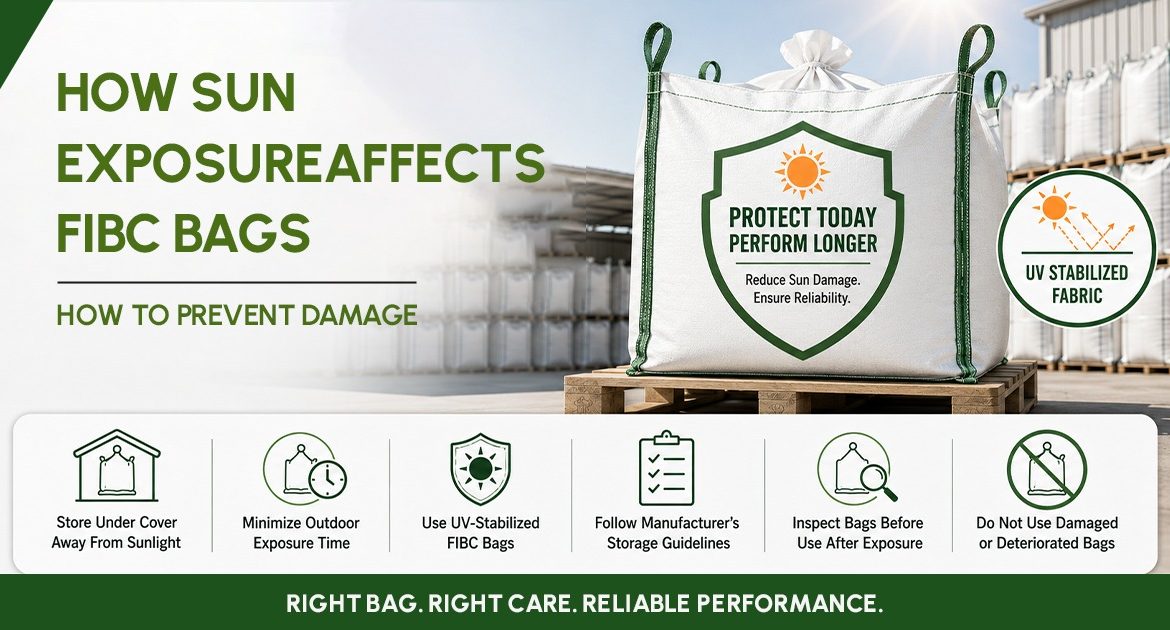
How to Prevent Sun Damage to FIBC Bags
The simplest way to limit UV-related degradation is to avoid unnecessary exposure whenever possible.
Businesses can take a number of practical steps:
- Store FIBC bags under cover and out of direct sunlight where possible.
- Do not leave filled or empty bags outside longer than necessary.
- Use UV-stabilised fabric where prolonged exposure is expected.
- Follow manufacturer’s recommendations for storage.
- Inspect bags that have had considerable exposure to the outdoors before putting them into service.
- Do not use bags if the fabric exhibits signs of major deterioration or damage.
These do not supplant correct bag selection. The specification of the FIBC and the storage conditions should be compatible to ensure safe and reliable performance.
How Storage Conditions Influence FIBC Service Life
Sunlight is not the only environmental factor that can affect a FIBC while it is in storage.
In addition, the condition of the bag can be affected by heat, moisture, dust, contamination, handling, physical contact, and long periods of storage. The bags are exposed to unnecessary environmental or mechanical stresses during poor storage before they are even put into use.
Accordingly, FIBCs should be stored under appropriate conditions, ideally in a manner that will protect them against unnecessary environmental exposure and physical damage.
To help keep them in good condition until they are needed, store bags in a clean, dry, and suitably covered storage area. In addition, the company should assess if the storage environment is compatible with the needs of the specific FIBC construction.
What Buyers Should Consider When Ordering FIBCs for Outdoor Use
Outdoor applications demand a closer look at the conditions in which the FIBC will be used.
Buyers should consider the expected duration of sunlight exposure, storage location, transportation conditions, and whether the bags will remain outdoors after filling before finalizing the bag specification.
Other specifications matter. The Safe Working Load, dimensions, lifting configuration, filling and discharge arrangement, coating, and liner should be chosen based on the intended application.
For applications with high UV exposure, UV stabilization should be discussed with the manufacturer as part of the overall bag specification.
This is a more reliable method than simply getting a standard bag and assuming it will work in any outdoor environment.
UV Protection and FIBC Selection at HPBL
The selection of a FIBC should be based on the material to be handled and the conditions under which the bag is to be stored, transported, and used.
HPBL offers FIBC solutions for industrial bulk handling applications with various constructions and configurations available depending on the application requirements. UV stabilization should be considered for bags that will be exposed to sunlight for prolonged periods.
Rather than automatically assuming UV protection is an absolute must for every FIBC, the expected exposure conditions should be considered when selecting the most appropriate bag construction.
This helps ensure the packaging specification matches the real-world operating environment without adding unnecessary features where not needed.
Conclusion
The polypropylene fabric used in FIBC bags is prone to degradation if left in sunlight for long periods. How much the UV breaks it down depends on things like how long it is exposed to UV, how strong the sunlight is, what the conditions are, and what the bag is made of.
UV-stabilized fabric can help improve resistance to UV-related degradation if the application involves significant exposure to the sun. But proper storage and handling are also critical to prevent unnecessary exposure and maintain the condition of the bags.
When choosing the FIBC, companies can consider expected storage, transport, and handling conditions to choose a suitable construction and ensure reliable packaging performance for the intended use.