


The European Union’s Packaging and Packaging Waste Regulation (PPWR) marks a major change in how packaging is designed, used, reused, recycled, and managed across the European market. For businesses that buy or use FIBC bulk bags, understanding these changes is becoming increasingly important.
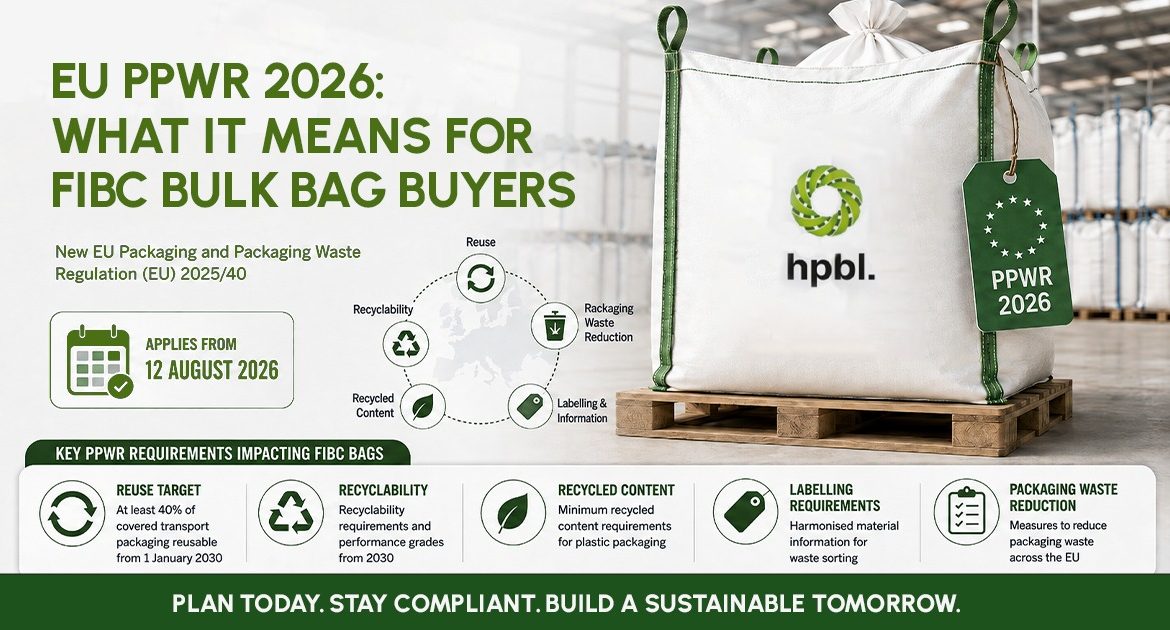
Regulation (EU) 2025/40 replaces the previous packaging and packaging waste framework and applies from 12 August 2026. It covers packaging placed on the EU market and introduces requirements covering recyclability, reuse, recycled content, labelling, and packaging waste reduction.
For FIBC buyers, one of the most important areas is transport packaging. The regulation specifically includes intermediate bulk containers, including flexible formats, within its reuse provisions. This makes PPWR particularly relevant to businesses using FIBCs in European supply chains.
What Is the EU PPWR?
The Packaging and Packaging Waste Regulation is an EU regulation designed to reduce packaging waste and improve the environmental performance of packaging throughout its lifecycle.
Unlike the previous directive-based framework, PPWR establishes harmonised requirements that apply across the EU. The regulation covers packaging design, recyclability, reuse, recycled content, labelling, and information requirements.
The regulation begins applying from 12 August 2026, although individual requirements have different implementation dates. This distinction is important because not every PPWR requirement becomes mandatory at the same time.
For FIBC buyers, the practical focus should therefore be on understanding which requirements apply today and which requirements need to be planned for over the coming years.
Why PPWR Matters to FIBC Bulk Bag Buyers
FIBC bags are commonly used as transport packaging for bulk materials. PPWR’s transport-packaging provisions specifically refer to intermediate bulk containers and include flexible formats.
From 1 January 2030, economic operators using covered transport packaging within the EU will generally need to ensure that at least 40% of such packaging overall is reusable within a reuse system.
This does not mean that every FIBC sold to an EU customer automatically has to be reusable from 2030. The requirements depend on how the packaging is used, the supply-chain arrangement, and the responsibilities of the relevant economic operator.
The regulation also contains specific rules for packaging used between sites belonging to the same operator or linked enterprises, making the actual supply-chain structure important when determining the applicable requirement.
The 2030 Reuse Requirements for FIBC Transport Packaging
The 2030 reuse target is one of the most significant PPWR developments for FIBC users.
Article 29 includes intermediate bulk containers of different sizes and materials, including flexible formats. From 1 January 2030, at least 40% of covered transport packaging used within the EU must be reusable within a reuse system.
The regulation also sets stricter requirements for certain internal or linked-company transport situations, where reusable packaging is required rather than simply meeting the overall 40% target.
For imported products, the European Commission’s 2026 guidance provides additional clarification. The reuse targets can apply after imported goods are placed on the EU market, from the first EU warehouse through to their final destination within the EU supply chain.
However, a consignment arriving at a first warehouse that is already destined for a single final destination does not automatically need to be unpacked and repacked into reusable packaging simply because it passes through that warehouse.
This means buyers need to evaluate their actual logistics route rather than assuming that one PPWR rule applies identically to every shipment.
What Does PPWR Mean for FIBC Reuse?
Under PPWR, reusable packaging is not simply packaging that can physically be used twice.
The regulation requires packaging to be conceived and designed for multiple rotations under normally predictable conditions of use. It must also meet applicable requirements relating to safety, hygiene, recyclability, and functionality.
For FIBC buyers, this makes the concept of a reuse system particularly important. A reusable FIBC needs to be appropriate for the intended handling cycle and supply-chain conditions rather than simply being stronger than a conventional bag.
Businesses considering reusable FIBCs should therefore evaluate how bags will be collected, inspected, handled, stored, and returned within the intended system.
The suitability of reuse will also depend on the material being packed and the application. A packaging solution appropriate for one product may not necessarily be suitable for another.
Recyclability Requirements for FIBC Packaging
Recyclability is another major part of PPWR.
The regulation requires packaging placed on the EU market to be recyclable and introduces recyclability performance grades based on design-for-recycling criteria. From 2030, packaging will generally need to meet the applicable A, B, or C recyclability grades, with stricter requirements coming from 2038.
For FIBC buyers, this means packaging construction may become an increasingly important part of procurement decisions.
The main material, coatings, liners, components, and overall bag construction can all influence how packaging is treated at the end of its useful life. Buyers should therefore consider recyclability alongside the functional requirements of the FIBC rather than treating it as a separate issue.
Recycled Content Requirements for Plastic Packaging
PPWR also introduces minimum recycled-content requirements for plastic packaging.
From 2030, the regulation establishes different minimum recycled-content percentages depending on the packaging category. For plastic packaging outside certain specified categories, the target is 35% recycled content recovered from post-consumer plastic waste, subject to the regulation’s conditions and implementation timeline.
However, this should not be interpreted as meaning that every FIBC must automatically contain 35% recycled polypropylene from 2030.
The applicable percentage depends on the classification of the packaging and the specific provisions of the regulation. In addition, PPWR provides exemptions for certain packaging applications, including packaging used for the transport of dangerous goods.
FIBC buyers should therefore confirm the applicable requirement for their specific packaging rather than applying a single recycled-content figure to every bulk bag.
Labelling and Information Requirements
PPWR also introduces harmonised packaging labelling requirements.
From 12 August 2028, or the later applicable date linked to the relevant implementing acts, packaging will generally need harmonised information about its material composition to support waste sorting.
The regulation also introduces specific requirements concerning reusable packaging and information that may be provided through standardised digital data carriers where applicable.
For FIBC buyers, future packaging specifications may therefore need to consider not only the physical construction of the bag but also how required information is provided and documented.
What Changed in 2026?
The important change in 2026 is that PPWR has moved from being a future regulatory framework to an applicable EU regulation.
The regulation applies from 12 August 2026, while many of its major packaging obligations are phased in over later years.
The European Commission has also issued 2026 guidance explaining how several provisions should be interpreted in practice, including the application of reuse targets to transport packaging and imported goods.
At the same time, implementation is continuing to develop. For example, the EU adopted a 2026 delegated decision providing exemptions from certain 100% reuse requirements for specific economic operators using pallet wrappings and straps. This decision concerns those specific packaging formats and should not be treated as an exemption for FIBCs.
For FIBC buyers, the broader lesson is that PPWR implementation should be monitored rather than treated as a one-time compliance exercise.
What Should FIBC Buyers Do Now?
Businesses supplying or using FIBCs in EU supply chains should start reviewing their current packaging arrangements before the 2030 reuse milestones arrive.
Key areas to review include:
- Identify where FIBCs are placed on the EU market and how they are used in the supply chain.
- Determine whether the FIBC falls within the transport-packaging provisions.
- Review whether current bags are intended for single use or could form part of a suitable reuse system.
- Discuss recyclability and material construction with the FIBC supplier.
- Review the materials used in coatings, liners, and other components.
- Keep relevant technical and compliance documentation available.
- Monitor upcoming EU guidance and implementing acts affecting packaging requirements.
The goal should not be to change every FIBC immediately. Instead, businesses should understand where PPWR may affect their particular packaging flows and begin planning for the requirements that will apply to them.
What Should Buyers Ask Their FIBC Manufacturer?
Communication with the FIBC manufacturer will become increasingly important as packaging requirements evolve.
Buyers can ask suppliers about the material composition of the FIBC, available construction options, suitability for the intended application, technical documentation, and whether particular packaging configurations are appropriate for reuse or recycling considerations.
It is also useful to explain the actual supply-chain conditions to the manufacturer. Information about the product being packed, transportation route, storage conditions, expected handling, and intended use can help the supplier understand the packaging requirements more accurately.
How HPBL Can Support FIBC Packaging Requirements
For businesses reviewing their FIBC requirements for European supply chains, the packaging specification should continue to be based on the actual product and application.
HPBL provides FIBC bulk bags and related packaging solutions that can be configured according to different handling, storage, and transportation requirements. FIBC liners and different bag constructions can also be considered where the application requires additional product protection or specific handling characteristics.
As PPWR requirements develop, buyers should discuss their intended application and regulatory requirements with their packaging supplier so that the appropriate FIBC specifications and supporting information can be considered.
Looking Ahead
PPWR is likely to make packaging selection a more detailed part of procurement decisions across European supply chains. Reuse, recyclability, material composition, documentation, and packaging information will increasingly need to be considered alongside traditional factors such as strength, capacity, and handling performance.
For FIBC buyers, the most important step is to understand how the regulation applies to their particular supply chain rather than assuming that every bulk bag will be subject to exactly the same requirements.
With the first major reuse targets beginning in 2030, businesses have an opportunity to review their current FIBC practices, discuss future requirements with suppliers, and prepare their packaging strategies before the later PPWR milestones take effect.
Conclusion
The EU PPWR introduces significant changes to the packaging industry, and FIBC bulk bags are part of this transition. The regulation is already applicable from August 2026, while important requirements relating to reuse, recyclability, recycled content, and labelling will continue to take effect over the coming years.
For FIBC buyers, early planning is more useful than making assumptions. Understanding the intended use of the bag, the supply-chain route, material construction, reuse possibilities, and applicable regulatory requirements can help businesses prepare for the changing European packaging landscape while continuing to meet their operational needs.