


The efficiency of storage and transportation systems is critical to agriculture. From harvested grains to planting seeds and fertilisers, large quantities of materials flow through the supply chain every day. Good handling, storage, and transportation of these products are necessary to maintain quality and minimise losses.
Agricultural products are frequently exposed to moisture, dust, contamination, and changing environmental conditions. If the packaging is not sufficiently protective, the product quality may degrade, and operating costs may rise.
That’s why FIBC bags are a popular solution in the agricultural industry. Known as bulk bags or jumbo bags, they allow businesses to store and ship large amounts of agricultural materials easily and safely.
Why FIBC Bags Are Widely Used in Agriculture
Packaging in modern agriculture has to be practical and cost-effective, but also able to handle large volumes.
FIBC bags are specially designed for bulk handling applications. Their large carrying capacity means agricultural businesses can move large quantities of product with fewer packages than conventional bagging methods.
This facilitates the processes of loading, unloading, storage, and transportation.
It also makes efficient use of warehouse space. FIBC bags are stackable and can be stored more efficiently than multiple traditional packaging options, enabling businesses to maximize available storage capacity.
They also cut down on packaging waste by reducing the number of individual bags needed for bulk materials.
The benefits mean better efficiencies across the supply chain for agricultural operations that routinely deal in grains, seeds, and fertilisers.
Key Challenges in Storing and Transporting Agricultural Products
While agricultural products might seem durable, they can be susceptible to a variety of environmental and handling conditions.
One of the most common problems is moisture. Too much moisture can lower product quality, lead to spoilage, or reduce the effectiveness of certain agricultural products.
Another issue is contamination. Dust, dirt, and foreign particles can affect the quality of stored products, especially seeds that require clean storage conditions.
Transportation also has risks. If the packaging is not strong enough, products may move in transit, and the packaging may get damaged, or material may be lost.
Some agricultural products are stored for long periods of time. Packaging shall continue to provide protection from environmental factors and maintain product integrity for long-term storage.
Common challenges include:
- Moisture exposure
- Product contamination
- Material loss during handling
- Long-term storage conditions
- Transportation-related damage
Understanding these risks helps businesses select packaging solutions that better protect their products.
Important Features to Look for in Agricultural FIBC Bags
The performance of an FIBC bag is a function of design and construction. Some features are particularly relevant to agricultural applications.
Strong woven polypropylene fabric forms the primary structure of most FIBC bags, providing high tensile strength while remaining lightweight and suitable for bulk handling applications. It gives the strength needed to carry heavy loads while still being lightweight and flexible.
Another important factor is the Safe Working Load (SWL), which specifies the maximum load the bag is designed to carry safely under normal operating conditions. The selected bag should have an SWL appropriate for the product weight and handling requirements.
UV stabilization can be useful when bags are likely to be exposed to sunlight during outdoor storage or transport. This helps maintain the strength of the fabric over time.
Agricultural businesses also have the option of coated and uncoated bags, depending on the product requirement. Coated bags can improve resistance to moisture and product leakage. For products that are highly sensitive to moisture, additional protection, such as FIBC liners, may also be required.
Take a look at fill and discharge options, too. Depending on the product, the system of filling or discharging may have to be different to make the handling more efficient.
Features to control dust can be particularly beneficial when working with fine agricultural materials, helping to keep storage and handling environments cleaner.
The right combination of features selected leads to enhanced product protection and operational efficiency.
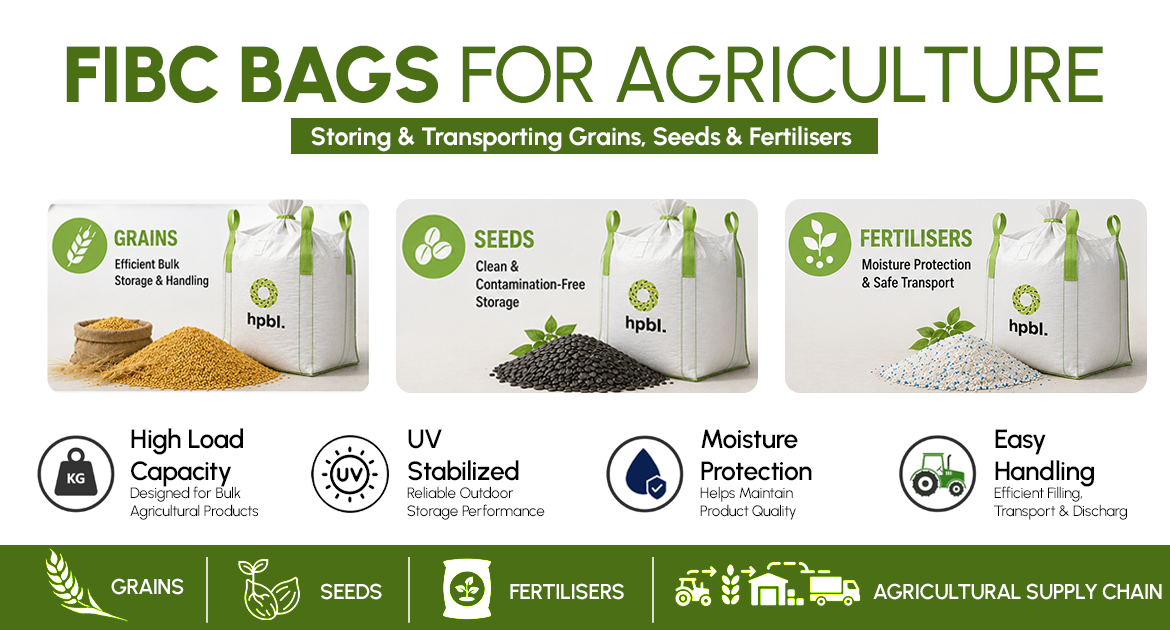
How FIBC Bags Support the Storage of Grains, Seeds, and Fertilisers
Different agricultural products have different requirements for storage and transportation.
Cereals
Grains are usually handled in large quantities and must be packaged for economical bulk movement.
FIBC bags help ease storage and transportation while also protecting from external contaminants. And the large capacity means fewer individual packages are needed.
Seeds
To safeguard seed quality during storage and distribution, seed should be stored in a clean environment.
Well-designed FIBC bags can limit exposure to contaminants and provide a controlled environment for handling large volumes of seed products.
Another benefit of efficiently moving large volumes is that it helps to streamline agricultural operations.
Fertilizers
Fertilizers are often susceptible to moisture and environmental factors.
FIBC bags help protect fertilisers from contamination during handling and, when appropriate bag constructions or liners are selected, can also improve resistance to moisture exposure.
Their strength and flexibility make them suitable for moving heavy loads through different stages of the agricultural supply chain.
By supporting the specific needs of grains, seeds, and fertilisers, FIBC bags offer a versatile packaging solution for the agricultural sector.
The Role of FIBC Liners and Customization in Agriculture
Additional protection may be necessary in some applications.
FIBC liners can be put inside bulk bags to provide an extra layer of protection between the product and the outside world. This extra layer can help reduce moisture exposure and improve product containment.
Liners are especially useful for products that need extra protection from environmental conditions.
Customization also plays an important role in agricultural packaging.
Products differ and may require specific bag sizes, filling systems, discharge options, or lift configurations. The application of these features to the application can improve handling efficiency and smooth operation.
You’re not just packaging the product; you want to make sure the packaging is conducive to the whole process of transportation and storage.
Choosing the Right FIBC Bag for Agricultural Applications
The proper FIBC bag is selected based on the knowledge of the characteristics of the product being handled.
This includes product type, storage time, environmental exposure, transportation conditions, and load requirements. All these things should be taken into account before you select a bag.
For example, products with a longer storage life may require greater protection from the environment. Likewise, UV-stabilized fabric may be beneficial for materials exposed to outdoor conditions.
Companies should also consider filling and emptying requirements in order to ensure that the bag fits smoothly into existing handling systems.
Collaborating with field-experienced manufacturers enables you to identify the bag design most appropriate for your specific agricultural application. Custom FIBC Bag Solutions: Companies like HPBL offer custom FIBC bag solutions to fulfill the handling, storage, and transportation needs of different industries, including agriculture.
Conclusion
The protection of quality and the efficient storage and transportation of agricultural products require a reliable packaging solution. The FIBC bag is a reliable choice, providing strength, flexibility, and bulk handling efficiency in one solution.
By choosing the right bag features, considering the specific needs of the product, and using extra protection where required, businesses can improve operational efficiency and help protect grains, seeds, and fertilisers along the supply chain.