


Bulk packaging, industrial textiles, ropes, and safety products need materials that can withstand regular use but remain lightweight and cost-effective. One material that has gained increasing importance in these applications is the PP multifilament.
Multifilament PP yarn is a durable, flexible, and strong material used in a wide range of industries. It is a dependable ingredient in many daily applications, from packaging and construction to agriculture and consumer products.
Knowing what it is, how it is made, and where it is used can help businesses to select the best material to suit their own needs.
What Is PP Multifilament Yarn?
PP multifilament yarn is a type of yarn manufactured from polypropylene, one of the most widely used thermoplastic polymers. Polypropylene is a widely used thermoplastic polymer. It is not from one single strand, but from many fine filaments that are spun together to make a stronger and more flexible yarn.
PP multifilament yarn consists of numerous continuous polypropylene filaments combined to produce a yarn with excellent flexibility, abrasion resistance, and tensile strength. Compared to monofilament yarn, multifilament yarn is generally more flexible and easier to handle while still providing reliable durability.
Besides, the material is lightweight, which is a practical choice for industries where weight reduction can improve efficiency and reduce transportation costs.
Because of these properties, the PP multifilament yarn has become popular for a variety of industrial and commercial applications.
How Is PP Multifilament Yarn Manufactured?
The manufacturing process begins with polypropylene granules being melted under controlled temperatures.
The molten polymer is then extruded through spinnerets to produce multiple continuous filaments. These filaments are rapidly cooled through a quenching process before being stretched through controlled drawing operations.
During drawing, molecular orientation takes place, which significantly improves the yarn’s tensile strength and overall performance. Depending on the intended application, the filaments may then undergo intermingling or twisting to achieve the desired yarn construction.
The yarn is subsequently heat-set to improve dimensional stability before being wound onto packages for further processing or use.
Good quality control is important throughout the production process. Denier, tensile strength, uniformity, and flexibility are closely monitored to ensure consistent performance.
The result is a durable yarn capable of meeting the demands of a wide range of industrial applications.
Key Properties and Advantages of PP Multifilament Yarn
The combination of strength and lightweight construction is the reason for the wide usage of PP multifilament yarn.
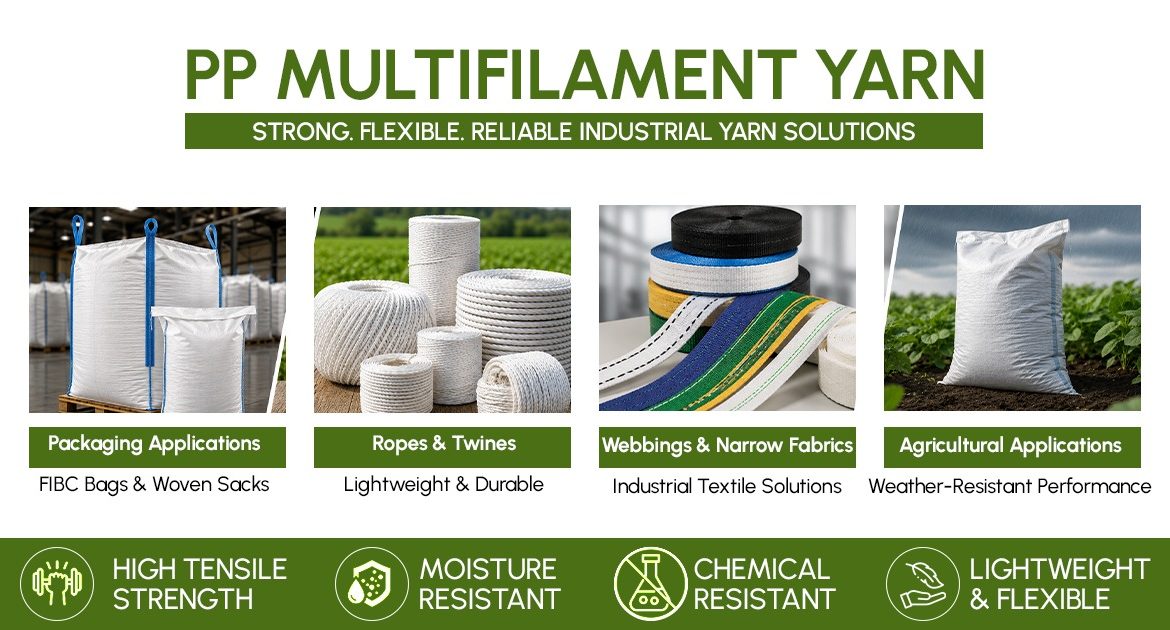
It has great tensile strength, so it can perform well under stress without adding unnecessary weight to the final product. PP multifilament yarn also has a low specific gravity of approximately 0.91, allowing it to float on water. This property makes it particularly useful in marine ropes and other applications where buoyancy is beneficial.
The material is also moisture-resistant, so it will still work well even in humid conditions. It doesn’t take in water as much as some other materials, reducing the chance of it breaking down over time. While the yarn is known for its durability, understanding how to take care of products made with PP multifilament yarn can help maximize product life and maintain consistent performance over time.
Another advantage is its resistance to many chemicals commonly found in industrial environments. PP multifilament yarn offers excellent resistance to most acids and alkalis; however, strong oxidizing agents may affect its performance.
PP multifilament yarn is known for its flexibility, too. This makes it ideal for applications where there is a need for repeated movement, bending, or handling. The yarn also offers excellent abrasion resistance, making it suitable for webbings, lifting accessories, and industrial textile applications that experience frequent wear and handling.
Additionally, polypropylene is recyclable, making it a practical option for businesses looking to support more sustainable manufacturing practices.
Common Applications of PP Multifilament Yarn
The PP multifilament yarn is a versatile product that can be used in a wide range of industries.
It is widely used in the packaging industry. In FIBC manufacturing, PP multifilament yarn is commonly used for sewing threads, lifting loop webbings, and accessory components. It is also used in woven sacks, webbings, and other industrial packaging materials where strength and durability are required.
The yarn is also used extensively for ropes and twines. It is lightweight, moisture-resistant, and can be used in outdoor and industrial applications.
In the textile industry, PP multifilament yarn is used for narrow woven fabrics, webbings, belts, and other industrial textile products.
It is also durable and weather-resistant, making it suitable for agricultural applications. It is found in products used in agriculture, storage, and handling.
The construction industry uses polypropylene-based materials in several applications where strength, flexibility, and long service life are important.
As industries continue to seek efficient and reliable materials, the demand for PP multifilament yarn continues to grow.
How to Choose the Right PP Multifilament Yarn
Selecting the right yarn depends largely on the intended application.
Another important factor is denier, which will affect the thickness and strength of the yarn. Depending on the load and performance expectations, the denier range needed is different for different applications.
UV resistance may also be a factor for products that are exposed to sunlight for long periods of time. UV-stabilized yarn can help improve durability in outdoor environments.
Businesses should also consider whether twisted, untwisted, or intermingled yarn constructions are more suitable for their application. The choice can influence flexibility, handling characteristics, and overall product performance.
Manufacturing consistency is equally important. Businesses should work with suppliers that maintain strict quality control processes to ensure reliable performance across different applications.
For instance, HPBL manufactures customizable polypropylene multifilament yarn solutions in a variety of denier ranges, yarn types, and UV stabilization options to cater to the needs of various industrial applications.
Why PP Multifilament Yarn Remains a Preferred Industrial Material
Industrial materials must balance performance, cost, and reliability. PP multifilament yarn continues to meet these requirements across a wide range of industries.
Its combination of strength, flexibility, chemical resistance, and lightweight construction makes it suitable for both simple and demanding applications.
The ability to customize yarn specifications further increases its usefulness across packaging, textiles, agriculture, and industrial manufacturing.
As industries focus on efficiency and long-term value, PP multifilament yarn remains a practical material that delivers consistent performance.
Conclusion
PP multifilament yarn has become an important material in modern industrial applications due to its strength, durability, and versatility.
From its manufacturing process to its wide range of uses, it offers several advantages that make it suitable for packaging, textiles, ropes, webbings, and other industrial products.
By understanding its properties and selecting the right specifications, businesses can choose a yarn solution that supports both performance and operational efficiency.