



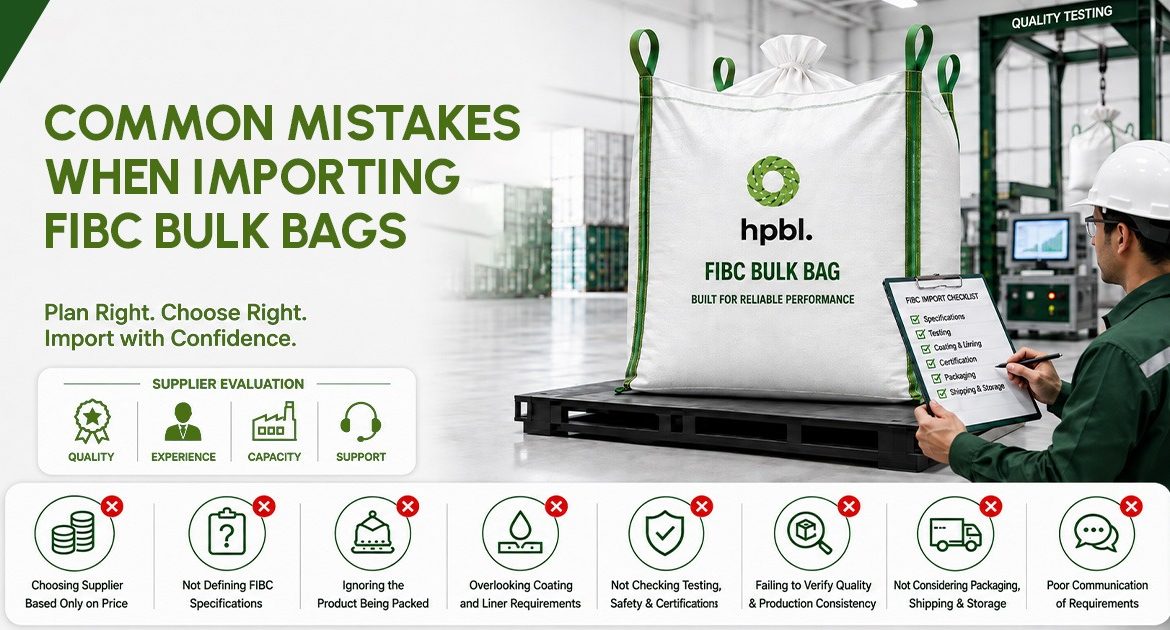
Importing FIBC bulk bags can help businesses source packaging suited to their products, handling systems, and supply chain requirements. However, choosing the right bags involves more than comparing prices between suppliers.
Incorrect specifications, unclear requirements, inadequate quality checks, or unsuitable bag construction can create problems after the order has been placed. These issues can affect product handling, storage, transportation, and overall operating efficiency.
For businesses sourcing FIBC bags internationally, understanding the common mistakes before placing an order can make the procurement process more reliable.
Choosing the Supplier Based Only on Price
Price is naturally an important consideration when importing FIBC bulk bags, but it should not be the only factor used to compare suppliers.
A lower quotation may not provide the same specifications, material quality, construction, testing, or consistency as another supplier. Differences in fabric, stitching, lifting loops, coating, liners, and other components can affect the final performance of the bag.
Instead of looking only at the initial purchase price, buyers should evaluate whether the supplier can consistently manufacture bags according to the agreed specifications and application requirements.
Supplier experience, production capabilities, quality control, customization support, and communication should all form part of the evaluation.
Not Defining FIBC Specifications Before Ordering
One of the most common mistakes is approaching a supplier without clearly defining what the FIBC needs to do.
The required specifications depend on the product being packed and how the bag will be filled, handled, stored, and discharged.
Before requesting a quotation, buyers should have a clear understanding of the required bag dimensions, Safe Working Load (SWL), filling and discharge arrangement, lifting configuration, fabric construction, and any coating or liner requirements.
The product’s characteristics should also be considered. A bag intended for a dry granular material may have different requirements from one used for a fine powder or material requiring additional moisture or contamination protection.
Clear specifications at the beginning help prevent misunderstandings later in the manufacturing process.
Ignoring the Product Being Packed
FIBC bags are used for many different types of bulk materials, but the same construction is not automatically suitable for every product.
Agricultural materials, food ingredients, chemicals, minerals, and industrial powders can have different packaging requirements.
Moisture sensitivity, particle size, product density, flow characteristics, contamination concerns, and chemical properties can all influence the appropriate FIBC design.
For chemical applications in particular, chemical compatibility between the packaged material and the polypropylene packaging system should always be evaluated before selection.
Importers should therefore provide the supplier with accurate information about the product instead of selecting an FIBC based only on its dimensions or load capacity.
Overlooking Coating and Liner Requirements
Another common mistake is assuming that every FIBC provides the same level of product protection.
Depending on the application, buyers may require coated fabric or an internal liner to provide additional protection against moisture, product seepage, contamination, or other environmental factors.
FIBC liners can be loosely inserted, glued, or stitched into the bag seams. HPBL’s documented product portfolio includes FIBC liners designed to provide additional properties such as anti-seepage, moisture barrier, oxygen barrier, chemical resistance, anti-static performance, and strength.
However, a liner should not be treated as a universal requirement. The appropriate solution depends on the product and the level of protection required.
Not Checking Testing, Safety, and Certification Requirements
FIBC safety requirements should be considered before production rather than after the bags have arrived.
The selected Safe Working Load should be appropriate for the intended application, and the required safety factor should be established according to the bag’s intended use and applicable requirements.
Testing requirements can also vary depending on the application. Buyers should clarify which tests, specifications, or certifications are required before placing an order.
For example, FIBCs intended for certain dangerous goods applications may require UN certification and compliance with applicable transportation regulations. This should be determined according to the material being transported and the relevant regulatory requirements rather than assumed for every FIBC.
Failing to Verify Quality and Production Consistency
A supplier may provide the correct specification on paper, but consistent manufacturing is equally important.
Before importing a large quantity, buyers should establish how the agreed specifications will be maintained throughout production. Fabric quality, dimensions, stitching, lifting loops, closures, and other relevant components should be manufactured according to the approved requirements.
Quality checks and appropriate pre-shipment inspections can also help identify problems before the goods leave the manufacturing facility.
Traceability can provide another layer of control by connecting production batches with relevant material and testing records where applicable.
For an importer, these checks are particularly valuable because identifying a quality problem becomes more complicated once a large shipment has already reached its destination.
Not Considering Packaging, Shipping, and Storage Conditions
The procurement process does not end when the FIBC bags are manufactured.
Bags can be exposed to moisture, contamination, sunlight, compression, and physical handling during transportation and storage. Appropriate packing and handling arrangements should therefore be discussed with the supplier and logistics provider.
Storage conditions at the destination should also be considered. For example, prolonged exposure to sunlight may require appropriate UV stabilization, depending on the application and expected exposure.
The objective is to ensure that the bags arrive in a condition consistent with the agreed product requirements.
Poor Communication of Requirements
Many avoidable problems begin with unclear communication.
Important requirements should be documented rather than relying on informal conversations. Buyers and manufacturers should have a clear understanding of the agreed specifications before production begins.
This can include the bag design, dimensions, SWL, lifting arrangement, filling and discharge system, fabric requirements, coating or liner requirements, printing, testing expectations, quantity, and packaging instructions.
Providing accurate product information is equally important. The more clearly the application is explained, the easier it becomes for the manufacturer to recommend an appropriate construction.
How to Make the FIBC Importing Process More Reliable
A reliable importing process starts well before the shipment is dispatched.
Businesses should first define the application and product requirements. These requirements can then be translated into specific FIBC specifications and shared clearly with potential suppliers.
Supplier capabilities should be evaluated alongside price, followed by confirmation of the required quality controls, testing, certifications, and production specifications.
Once production begins, maintaining clear communication and appropriate quality checks can help reduce the possibility of receiving bags that do not match the agreed requirements.
Finally, transportation, receiving, and storage conditions should also be considered so that the bags remain suitable for use after arrival.
Choosing an Experienced FIBC Manufacturing Partner
The choice of manufacturing partner can have a significant influence on the consistency of imported FIBC bulk bags.
A manufacturer with experience across different applications can help buyers understand how factors such as bag construction, liners, filling and discharge systems, and load requirements affect the final product.
At HPBL, FIBC bags form part of the company’s core product portfolio. The company’s documented product range includes FIBCs for storing, transporting, and handling dry granular and/or slurry materials, along with FIBC liners for applications requiring additional protection or performance characteristics.
This type of application-focused manufacturing approach allows the FIBC specification to be considered in relation to the material and intended use rather than treating every bulk bag as the same product.
Getting the Specification Right Before Importing
Importing FIBC bulk bags successfully starts with making the right decisions before the order is placed.
Price, supplier capability, product characteristics, bag specifications, testing requirements, liner or coating needs, quality controls, and transportation conditions all deserve consideration.
The more clearly these requirements are established before production, the lower the likelihood of avoidable specification or quality issues after the shipment arrives.
For businesses sourcing FIBC bulk bags internationally, careful supplier evaluation and clear technical communication can make the difference between simply importing packaging and sourcing a solution that works reliably within the intended operation.