


Different industries have very different requirements for bulk packaging. Food ingredients, agricultural products, chemicals, minerals and industrial powders are all different materials and have different requirements for handling, storage and transportation. These differences mean that a standard FIBC bag might not always be the ideal packaging option.
One of the major benefits of Flexible Intermediate Bulk Containers (FIBCs) (also known as bulk bags/jumbo bags) is their ability to be customized for specific applications. Customization can help businesses with better product protection, handling efficiency, and supply chain performance. From bag sizes and lifting configurations to filling systems and protective liners, customization can help.
Knowing the customization options available, businesses can choose the right type of FIBC bag that meets their operational requirements and guarantees safety, quality, and dependability.
Why FIBC Bag Customization Matters
Each bulk material behaves differently when it is stored, transported, filled, and discharged. This depends on the density of the product, size of the particles, sensitivity to moisture, the handling equipment, and the storage conditions.
The FIBC bag is customized to ensure that the packaging meets these specific requirements, rather than having a one-size-fits-all solution. The right configuration can optimize loading and unloading, minimize product loss, protect materials from the environment, and simplify handling across the supply chain.
Selecting the proper bag design can lead to smoother operations and better long-term performance for industries that handle bulk materials on a daily basis.
What Can You Customize in an FIBC Bag?
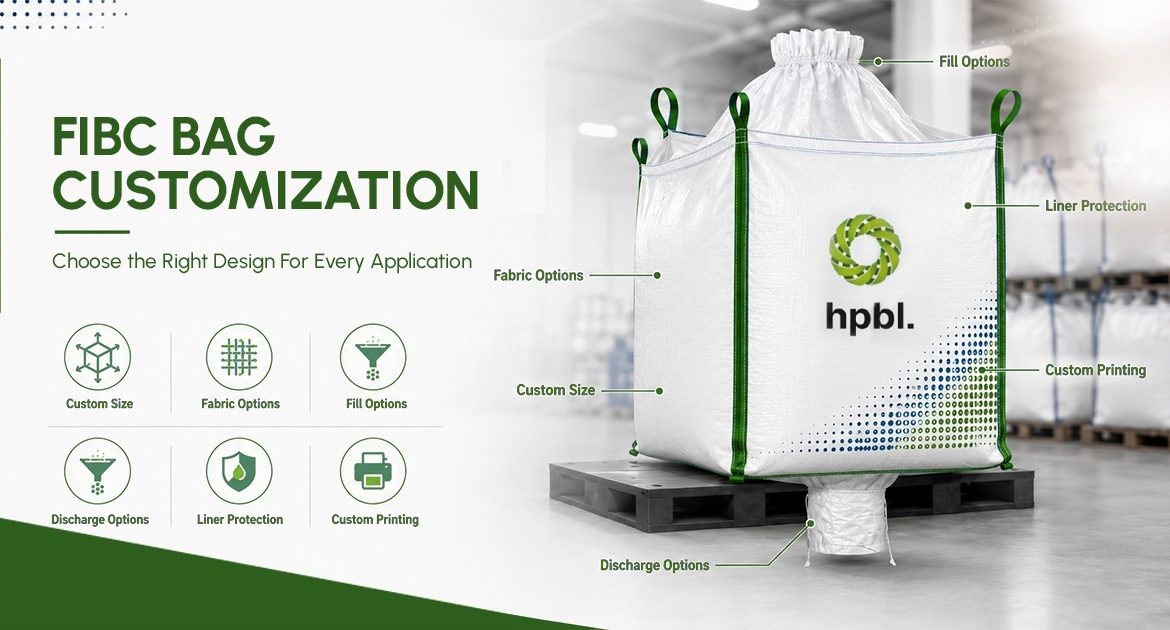
FIBC bags can be set up in various ways to suit different industrial requirements. The best combination depends on the material to be handled, the operating environment, and the handling process.
Size and Capacity of the Bag
One of the first things to consider is the right size and load capacity of the bag.
The required size depends on the bulk density of the product, available space for storage, mode of transportation, and handling equipment. The dimensions will be correct in order to make storage as efficient as possible, and the bag will be able to safely hold the weight of the product it is meant to carry.
Instead, businesses should select a size that will allow for efficient filling, stable stacking, and safe transportation, not simply the largest bag available.
Fabric and Construction
The way the woven polypropylene fabric is constructed has a major impact on the performance of a FIBC bag.
Businesses can select coated or uncoated fabric depending on the application. Coated fabrics can provide greater resistance to moisture ingress and can help minimise product sifting, whereas uncoated bags might be suitable for products which require no further barrier protection.
UV stabilised fabric can also be chosen for applications where bags are likely to be exposed to sunlight during storage or transit. It also helps to keep the fabric strong, even after extended periods of outdoor use.
The right construction of fabric will ensure that the bag is reliable in storage, handling, and transport.
Filling and Discharge Options
Different products and different production processes require different filling and emptying systems. Common options for customization include:
- Open top for fast, easy filling.
- Duffle top for easy manual filling and secure closure.
- Spout for controlled loading of goods.
- Stable storage on a flat bottom.
- Controlled product emptying discharge spout.
- Fully open bottom for quick dumping of selected bulk materials.
Correct filling and discharge configuration can improve operational efficiency, minimize product loss, and ease material handling.
Lifting Loop Configurations
Lifting loops define the handling of a FIBC bag during transport and storage.
Different industries use forklifts, cranes, automated handling systems, etc., and loop configuration is an important design consideration. Typical lifting configurations are cross-corner loops, side-seam loops, and corner loops and are selected based on the handling equipment and operation requirements of the customer.
Choosing the right lifting configuration can help you boost your handling efficiency while still encouraging safe lifting practices.
FIBC Liners
Some products require additional protection in addition to the woven polypropylene bag itself.
FIBC liners offer an extra barrier between the product packed and the outside world. They can reduce moisture exposure, improve the cleanliness of the product, reduce the chance of contamination, and provide better containment for fine powders.
Different liner options are available based on application requirements. The selection of the correct liner is dependent on the characteristics of the product, storage conditions, and required level of protection.
HPBL also provides FIBC liner solutions in order to complement its bulk packaging systems when additional product protection is needed.
Printing and Product Identification
Printing is another great option for customization, especially for businesses with large inventories or those that supply products to a number of customers.
Custom printing can include company branding, product descriptions, handling instructions, safety information, batch identification, and other operational details. Proper identification makes warehouse management easier, helps track items back to their source, and ensures products are handled correctly throughout the supply chain.
Safety Features and Special Requirements
In some applications, additional safety or regulatory considerations are necessary in selecting a FIBC bag.
Depending on the product being carried and what it is used for, a business may require specifications. This could include a Safe Working Load (SWL), correct safety factors, food-grade construction, UN-certified bags for the transportation of hazardous materials, or electrostatic protection using Type A, Type B, Type C, or Type D FIBCs.
The safety features required are highly application-specific and should be selected based on product features, handling conditions, and relevant industry standards.
How to Choose the Right FIBC Bag Configuration
The right configuration is chosen by taking into account a number of operational factors, such as:
- Product description and properties.
- Load capacity needed.
- Filling and discharging process.
- Storage and transport conditions.
- Moisture sensitivity.
- Handling equipment
- Safety and compliance needs.
- Product protection standards.
These factors combine to help businesses choose an FIBC bag configuration that promotes both operational efficiency and product safety.
Working with an Experienced FIBC Manufacturer
But customization of an FIBC bag is more than just selecting individual features. The various specifications must be compatible with each other to meet the requirements of the intended application.
An experienced manufacturer can evaluate the product’s characteristics, handling procedures, storage conditions, and transportation requirements and then suggest an appropriate bag configuration.
HPBL provides tailor-made FIBC bag solutions for a wide range of industrial applications. HPBL assists businesses in choosing suitable dimensions, fabric construction, lifting options, liners, and other specifications depending on their operational needs. This application focus ensures each packaging solution is designed to support reliable performance across the supply chain.
Conclusion
FIBC bag customization enables businesses to choose packaging solutions that match the specific requirements of their products and operations. From bag dimensions and fabric construction to lifting loops, liners, filling systems, and safety features, each specification contributes to product protection, efficient handling, and reliable transportation.
By understanding the available customization options and selecting the right combination of features, businesses can improve operational efficiency while supporting safe and dependable bulk material handling across a wide range of industries.