


Agriculture, food processing, chemicals, construction, and mining all process bulk materials on a daily basis. Companies that need to transport large quantities of material safely and efficiently use Flexible Intermediate Bulk Containers (FIBC bags) to carry grains, industrial powders, or chemical products.
The performance of a FIBC bag is not only based on the design, but also on the quality checks and testing processes during manufacturing. If the bag is not of a desired quality, there can be loss of product, handling problems, or safety hazards during storage and transportation.
Knowing the testing procedures used on FIBC bags before they leave the factory allows businesses to understand the importance of quality control and select packaging solutions that provide consistent performance throughout the supply chain.
Why Testing Matters in FIBC Manufacturing
Testing is an important step in the development of reliable bulk packaging solutions. This helps to verify that the FIBC bags can perform as designed under normal handling, storing, and transportation conditions.
Quality testing also ensures manufacturers that each production run will be consistent. The quality of the product is monitored during the manufacturing process to identify and correct any variations before the bags are shipped to customers.
Reliable packaging makes operations safer and supply chains more efficient in industries that deal with heavy, valuable, or regulated materials.
Testing ultimately helps to build confidence that the packaging solution will meet the expected performance requirements for the intended application.
Quality Checks Throughout the Manufacturing Process
Quality control does not start the moment a bag is finished. That is part of the manufacturing process at different stages to help ensure consistent product quality.
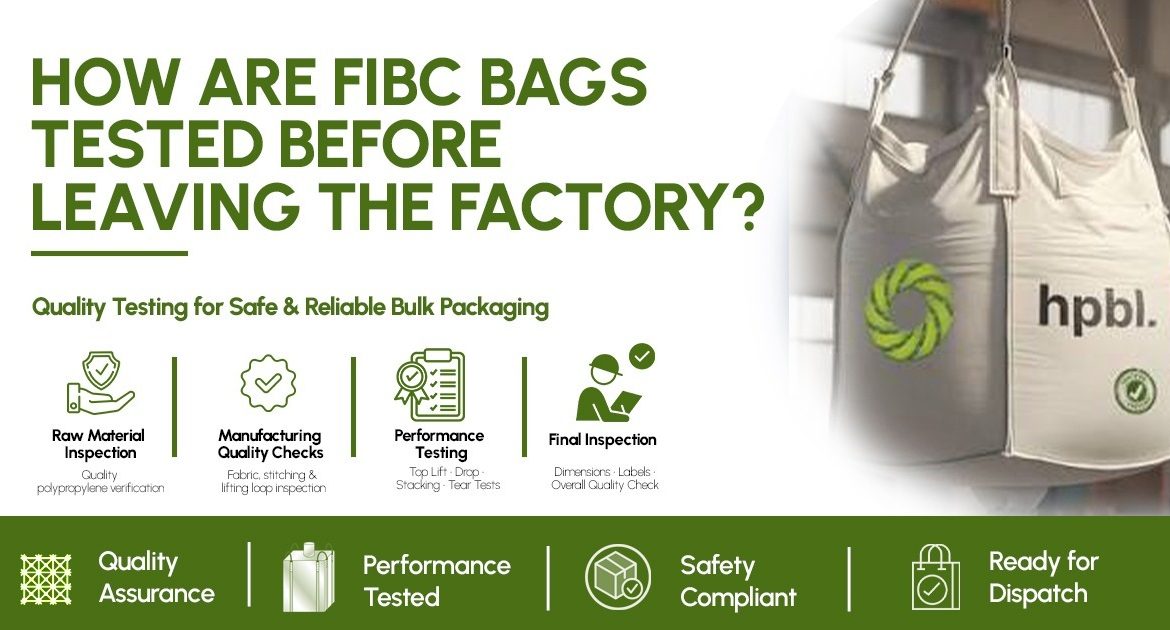
The process usually starts with inspection of the raw materials of polypropylene before production begins. The quality of the woven fabric, consistency of the tape, stitching, webbings and lifting loops are all closely monitored during manufacture to help maintain uniformity.
Dimensional checks are also carried out to confirm the finished bag complies with the required specifications. Visual inspection is used to identify any defect that may affect the appearance or performance.
Monitoring each stage of production allows manufacturers to achieve greater consistency and quality assurance before products are ready for dispatch.
Common Performance Tests for FIBC Bags
Performance criteria of FIBC bags can be tested to prove that they will perform as required for the design and application. The specific tests performed are based on bag design, customer specifications, and applicable industry standards.
Top of Lift Test
The top lift test is meant to test the lifting loops and the overall construction of the bag. The bag is lifted in a controlled manner using the intended lifting points so that it can safely lift its rated Safe Working Load (SWL).
Stacking Test
Bulk bags are usually stored in warehouses or transported stacked up. Stacking test: The stacking test measures the ability of the bag to withstand compressive loads when stacked without influencing the structural integrity of the bag.
Drop Test
Where necessary for the application, such as some UN-certified FIBC bags, controlled drop tests are performed to determine the bag’s performance during an accidental drop during handling. This helps verify the bag’s resistance to impact under specified test conditions.
Tear test
The tear test measures the resistance of the woven fabric and stitched construction to tearing when loaded. This helps to check the durability of the bag when handled normally.
Test righting
The righting test is carried out to determine the resistance of the bag to stresses which can be imposed when a filled bag is overturned and then righted during handling.
Further tests for specific applications
Depending on customer requirements or transportation conditions, additional evaluations such as vibration testing or other application-specific performance tests may also be conducted to evaluate suitability for particular operating environments.
How Safety Standards Influence Testing
Testing is closely linked with FIBC safety standards used throughout the industry.
One of the main specs is the Safe Working Load (SWL). This is the maximum weight that the bag is designed to carry safely during normal use.
The manufacturer takes into consideration the safety factor, which is the ratio between the tested breaking load and the Safe Working Load. Typical safety factors are 5:1 for single-trip bags and 6:1 for multi-trip bags under controlled conditions.
ISO 21898 specifies requirements and testing methods for Flexible Intermediate Bulk Containers. A huge number of FIBC bags are manufactured and tested to this standard.
For hazardous materials, UN-certified FIBC bags may be required. Also, these bags are subject to further testing and must comply with applicable dangerous goods transportation regulations before being approved for use.
Understanding these standards helps businesses select packaging solutions that are appropriate for their products and handling requirements.
Final Inspection Before Dispatch
The finished FIBC bags are usually inspected by the manufacturers before dispatch to ensure they comply with the specified requirements.
This inspection may include an inspection of:
- Overall dimensions of bag
- Quality of seams
- Webbing and lifting loops
- Marking and printing of products
- Labels & ID
- Cleanliness of the finished bag.
- Overall workmanship and visual look
The objective is to verify that the bags supplied to customers meet the approved design and manufacturing standards.
Why Choosing an Experienced Manufacturer Matters
Testing does not guarantee the quality of the product. The overall performance of an FIBC bag is a result of consistent manufacturing practices, reliable raw materials, and well-controlled production processes.
With an experienced manufacturer, a business can find packaging solutions that are tailored to their specific applications and supported by proven quality control procedures. Those with solid technical expertise are better positioned to guide the manufacturer, too, on bag design, load capacity, safety requirements, and product customization.
HPBL provides FIBC bag solutions for a wide range of industrial applications with a strong focus on consistency of manufacturing, product quality, and reliable packaging performance.
Conclusion
FIBC bags are subjected to a number of quality checks and performance tests before leaving the factory to help ensure that they are suitable for their intended applications. The reliability and safety of the product are ensured by the inspection of raw materials, quality control during manufacturing, performance testing, and final inspection.
Understanding the testing process of FIBC bags allows businesses to make informed packaging decisions and choose solutions that enable efficient storage, handling, and transportation. By partnering with experienced manufacturers who adhere to consistent quality practices, companies can boost operational efficiency and mitigate packaging-related risks throughout the supply chain.