


Flexible Intermediate Bulk Containers (FIBC bags) are designed to safely and efficiently store and transport large quantities of bulk materials. FIBC bags are used by businesses for everything from agriculture to food processing, chemicals, construction, and mining to improve handling, reduce packaging costs, and optimize storage space.
But selecting the right FIBC bag is not merely about selecting a bag that can hold sufficient load. The dimensions, volume, filling and discharging systems, product density, and handling methods are all important considerations in determining the most appropriate packaging solution.
Choosing the right bag size increases operational efficiency, maximizes transportation capacity, and protects products throughout the supply chain. For companies looking to make smarter packaging decisions, knowing how FIBC bag dimensions correspond to different applications is a valuable asset.
Why FIBC Bag Dimensions Matter
The size of an FIBC bag has a direct impact on the efficiency with which materials can be stored, transported, and handled.
If the bag is too small, more packaging units may be required, which increases handling time and transport costs. In contrast, a bag that is too big may not be an effective use of space in warehouses or containers and may have an impact on handling performance.
Choosing the right dimensions helps businesses to:
- Optimize storage utilization
- Improve loading/unloading procedures
- Reduced transportation costs
- Maintain product stability in handling
- Maximize warehouse space utilization
Properly selecting the dimensions helps ensure that the bag will perform properly when being filled, lifted, stored, and emptied.
Understanding FIBC Bag Dimensions
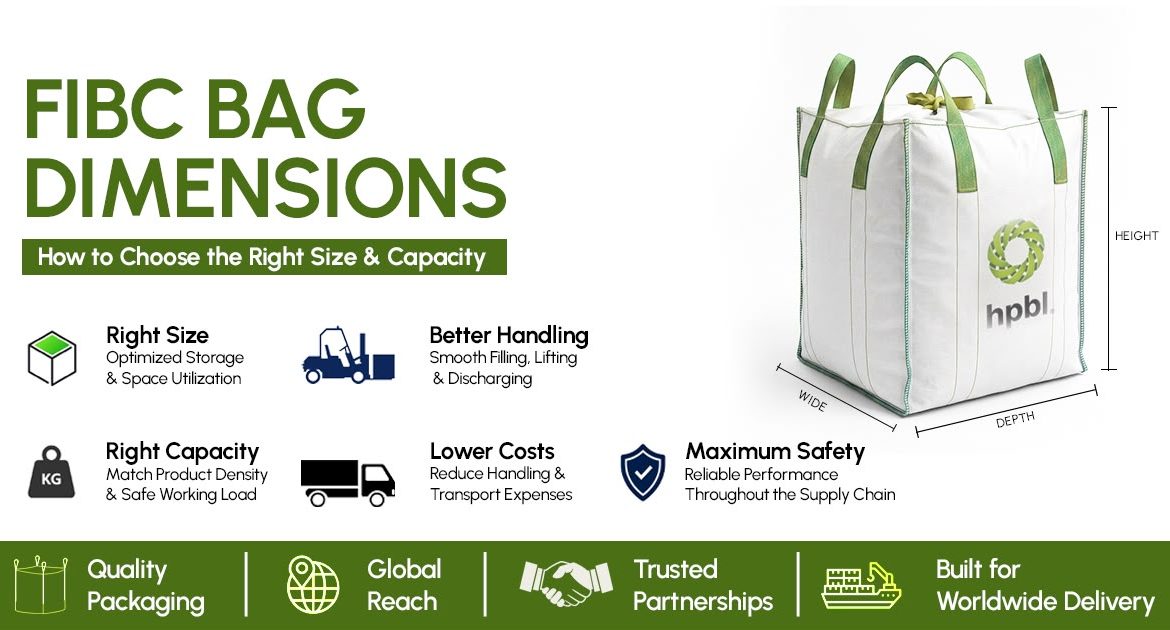
The dimensions of FIBC bags are usually defined by three dimensions:
- Depth
- Width
- Height
These measurements determine the overall size of the bag and how much material it can hold safely.
But the total capacity is not a function of dimensions only. The bulk density of the product being packed is an important factor in determining the amount of material that the bag can carry whilst remaining within its Safe Working Load (SWL).
For example, lighter materials may require larger bags, and heavier materials may require smaller bags with the same SWL to avoid overloading.
So when you choose dimensions, you always have two things to think about:
- Volume of product
- Weight of product
Factors to Consider When Choosing the Right FIBC Bag Size
Every bulk material has its own packaging needs. Selecting the right size involves a number of operating considerations.
Bulk Density of Product
One of the most important considerations is bulk density.
Materials with low densities take up more space and usually need larger bags. High-density materials require smaller bag volumes to remain within the permitted load capacity.
Understanding the density-volume relationship helps you avoid both underutilized packaging and overstuffed bags.
Safe Working Load (SWL)
The bag sizes should always be complementary to the Required Safe Working Load.
Even with a bag that has an adequate internal volume, it should never be filled beyond its rated SWL. Choosing the right size helps ensure safe lifting, transportation, and storage.
Requirements for Filling and Discharge
Preferred bag dimensions may be influenced by different filling and emptying systems.
Companies can choose bags depending on operational requirements.
- Top fill nozzles
- Open-top construction
- Bottom Discharge Spout Silos
- Flat bottoms.
The right configuration can improve the handling efficiency and reduce the loss of product during filling and discharge.
Shipping & Storage
Factors like warehouse layout, pallet dimensions, shipping containers, and transportation should be considered before deciding on bag dimensions.
Properly sized FIBCs help:
- Enhance stacking stability
- Maximize container usage
- Minimize empty transport space
- Better organization of the warehouse
Selecting dimensions that are compatible with existing logistics systems can help to ease the flow of supply chain operations.
Common FIBC Bag Sizes Available
The sizes of bags required by different industries depend on the properties of the products and the requirements of handling.
HPBL manufactures a variety of customized sizes of FIBC bags to suit different industrial applications instead of just standard sizes.
Variation in common customization options includes:
- Width
- Length
- Height
- Filling volume
- Safe Working Loads
- Fabric construction
- Fill and discharge configurations
The final size is chosen depending on the product characteristics of the customer, the handling means, the storage requirements, and the transport conditions.
This flexibility allows businesses to select packaging solutions that better fit their operations, rather than having to change their operations to fit standard bag sizes.
How Product Type Influences Bag Dimensions
The size of the bag will vary for different products because the physical characteristics of products vary widely.
Agricultural Produce
Agricultural products, such as grains, seeds, animal feed, etc., are typically shipped in bulk. The size of the bags is selected according to the product density, storage period, and transportation.
Ingredients for food
Bulk food products such as flour, sugar, starch, and other dry ingredients may require dimensions that allow for efficient filling while maintaining product quality and facilitating safe handling.
Chemicals
Product density often requires dimensions for chemical powders and granules, and the appropriate liner, filling system, or static-protection bag type, as required.
Construction & Industrial Materials
Sizes are usually needed for products like minerals, building materials, and industrial raw materials that can bear heavy loads and are compatible with lifting equipment and storage systems.
Selecting bag dimensions according to product characteristics helps improve handling efficiency across different industries.
Customization Options Beyond Bag Dimensions
Dimensions are just one part of a good FIBC solution.
Businesses may also customize, depending on application requirements:
- Filling systems
- Discharge alternatives
- Loop configurations
- Coating of fabrics, UV stabilisation
- Printing & Branding
- FIBC liners where extra product protection is needed
Selecting the correct combination of dimensions and construction features also helps to enhance operational performance and product protection.
HPBL provides Customized FIBC Bag Solutions to meet the unique storage, handling, and transportation needs of various industries through a consistent quality standard.
Common Mistakes to Avoid When Selecting FIBC Bag Dimensions
Selecting bag dimensions based on capacity alone can create operational difficulties.
Common mistakes include:
- Disregarding product bulk density
- Choosing bags based on volume only, not SWL
- Dimensions of the warehouse or container are ignored
- Choosing inappropriate filling or discharge configurations
- Not taking into account long-term storage and handling requirements
Knowing the full application in advance when choosing dimensions helps businesses to avoid unnecessary packaging problems.
Conclusion
Choosing the right size of an FIBC bag is a critical step towards safe, efficient, and economical bulk packaging. Product density, safe working load, handling, storage, and transportation of the bags, etc., are several factors determining the right bag size.
Instead of relying on standard dimensions, businesses can benefit from selecting custom FIBC bag solutions that are tailored to their specific operational requirements. By looking at these things closely, companies can improve how they handle goods, use storage space more effectively, and better protect products throughout the supply chain.
Manufacturers like HPBL cater to a variety of industries through tailored FIBC bags that meet different packaging and logistics needs with an emphasis on quality, safety, and reliability.