


Bulk packaging is more than just choosing the right bag size or load capacity. Additional protection is often required to help maintain product quality during storage, handling, and transportation. This is especially important for industries such as agricultural chemicals, food processing, minerals, and industrial manufacturing where moisture, contamination, or product leakage can impact performance.
Coated fabrics and FIBC liners are two common methods to improve the protection of products in Flexible Intermediate Bulk Containers (FIBCs). Both are meant to add additional protection, but they are meant for different things and work well for different applications.
By understanding the difference between coatings and liners, companies can select the appropriate packaging solution for their products, handling conditions, and operating requirements.
What Is a Coated FIBC Bag?
A coated FIBC bag is produced from woven polypropylene fabric that is laminated with a thin layer of polypropylene during manufacturing. The coating creates a protective surface on the fabric and helps to restrict moisture and fine particles from moving through the woven structure.
The coating is not an additional component but becomes part of the fabric. Coated bags have better resistance to moisture and product leakage than uncoated bags. However, coated bags are not completely moisture-proof and may not provide sufficient protection to products with strict barrier requirements.
Coated FIBC bags are still lightweight but provide greater durability and product containment for many bulk products, since the coating is built into the fabric.
What Is an FIBC Liner?
An FIBC liner is an inner bag that is separate from the woven FIBC, sitting inside the FIBC. Unlike a coating, the liner forms an independent barrier between the product and the outer woven bag.
Liners are often used when products require additional protection against moisture, contamination, oxygen, or product migration. Various liner designs are available to suit the handling and protection requirements of the application.
For applications requiring an additional level of product protection, HPBL provides FIBC bags with liner options, enabling customers to choose packaging solutions that are appropriate for their material handling needs.
Coating vs Liner: Understanding the Difference
Coatings and liners both help protect products, but they do it differently.
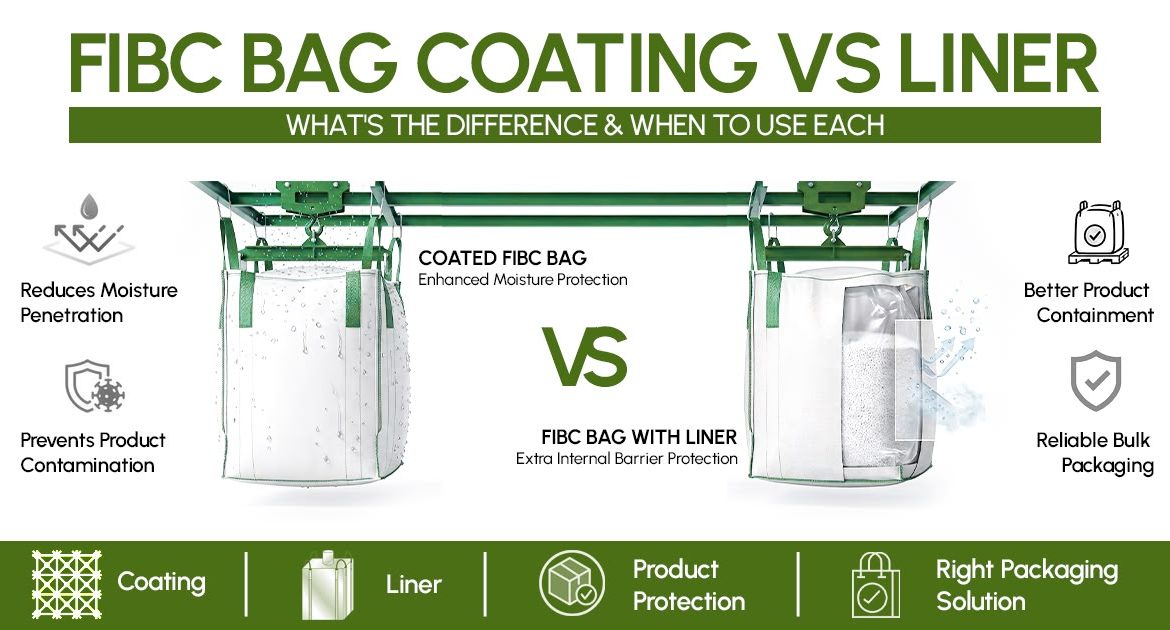
A coated bag enhances the performance of the woven fabric itself by reducing moisture penetration and minimizing product sifting through the fabric. It offers a practical solution to many general industrial and agricultural applications.
However, an FIBC liner is an independent barrier inside the bag. It is independent of the outer bag and thus offers increased protection against moisture, contamination, and product leakage. Some liner materials can offer better barrier properties for products with more demanding packaging requirements.
The choice depends on many factors, including the nature of the material to be packaged and the level of protection required during storage and transport.
When Is a Coated FIBC Bag the Right Choice?
For many bulk products, FIBC bags with a coating are perfect for offering some protection from the elements but without the need for a full internal barrier.
They are often chosen for products that:
- Require lower moisture penetration under normal storage and transit
- Enjoy greater resistance to product sifting
- Want an affordable packaging solution that provides extra protection
- No need for special barrier properties
Coated bags retain their handling characteristics because the coating is permanently bonded to the fabric, so there’s no need to install an additional liner.
When Should You Choose an FIBC Liner?
Certain products require more protection than coated fabric can provide. FIBC liners play an important role in the packaging system in such cases.
Commonly preferred liners are:
- Products are very moisture-sensitive
- Contamination control is important
- Need better product containment for fine powders
- Additional properties of oxygen or a vapor barrier are required
- Special conductive liners are required for static protection
Different liner types can be used depending on the application, e.g., form-fit liners, loose liners, conductive liners, aluminium foil liners or EVOH barrier liners, as long as they provide the required protection.
Can Coated Bags and Liners Be Used Together?
Yeah. Coated FIBC bags and liners are often used together in many industrial applications to provide higher levels of product protection.
The outer fabric is coated to enhance the durability of the bag and to reduce moisture penetration through the woven material. Simultaneously, the inner liner offers an additional barrier to protect the product from contamination, moisture, and product migration.
This combination is frequently chosen for products needing more protection during long-haul transportation, extensive storage, or rough handling situations.
The most suitable combination depends on product characteristics, storage conditions, transportation methods, and customer requirements.
Factors to Consider Before Choosing
The decision between a coated FIBC bag, an FIBC liner, or a combination of both is not a one-size-fits-all decision. The decision should be made based on the application.
Some of the important considerations are:
- Product Moisture Sensitivity
- Risk of pollution
- Particle size and risk of product leakage
- Length of time stored and exposed to the environment
- Conditions of transport
- Customer/regulatory specific packaging requirements
This assessment enables businesses to choose packaging that will help to protect products and improve operational efficiency.
Choosing the Right Solution for Your Packaging Needs
Each bulk material requires different packaging. FIBC bags with coating are a practical choice for protecting a wide range of industrial products; however, some products require the additional barrier of an FIBC liner.
Working with an established packaging manufacturer can help companies determine which choice best meets their operational needs. HPBL provides coated bags and liner options for a variety of industries and bulk packaging applications to meet the needs of various FIBC bag solutions.
Choosing the right configuration will help to improve product protection while allowing for efficient storage, handling, and transportation throughout the supply chain.
Conclusion
While both coated FIBC bags and FIBC liners play a significant role in bulk packaging, they are used for different purposes. The coating improves the woven fabric’s performance by reducing moisture penetration and product sifting. A liner provides a separate inner barrier for applications that require more protection.
Grasping the difference between these two solutions enables companies to select packaging appropriate to their products and operating environments. Choosing the correct coating and liner combination, when applicable, can enhance product quality, reduce the risk of handling, and facilitate more dependable bulk packaging operations.