



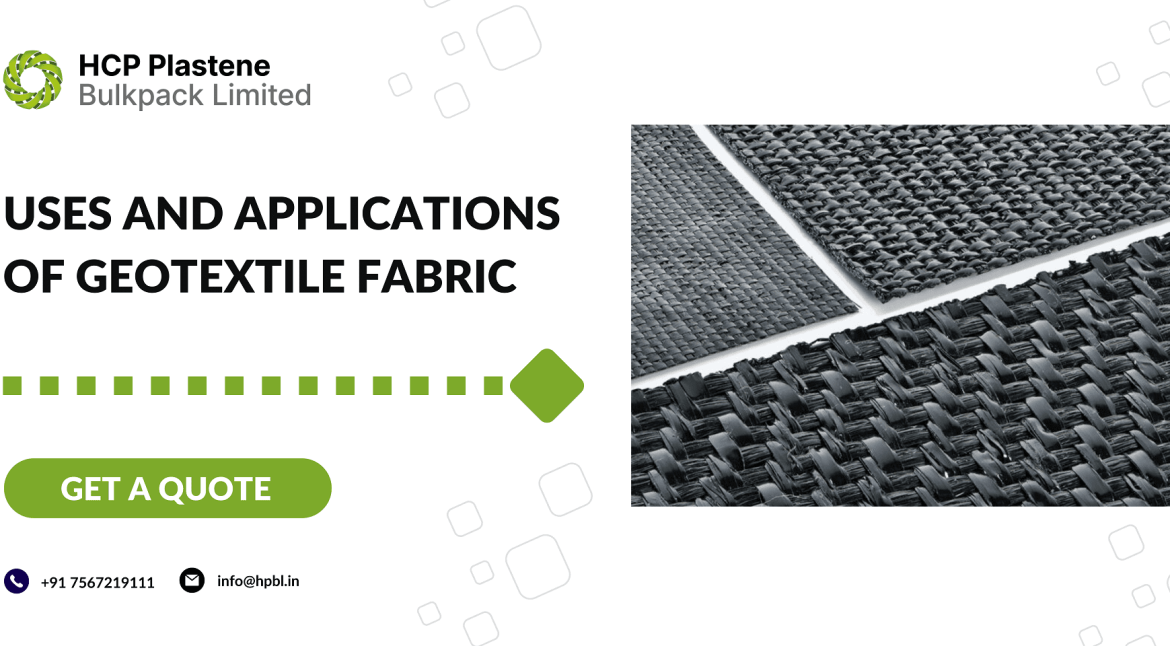
Geotextiles are breathable fabrics made mostly of polypropylene and polyester. Depending on the process of production and the kind of use they are designed for, they can be either woven or non-woven. Fabrics that are woven and nonwoven are produced using various techniques. In contrast to woven textiles, which have these yarns, filaments, or other parts interlaced, non-woven geotextile fabric is made of fibres, filaments, or other elements that are randomly connected together. In this article, we will be discussing the various applications and uses of geotextile fabric in detail.
Woven Geotextile Fabrics
Any material created by weaving together two or more yarns, fibres, filaments, strips, or other components, often at right angles, that is, both longitudinally and crosswise, using a textile method, is referred to as a woven geotextile fabric. These materials are mostly used in the building industry. Thus, the “simple pattern” approach, which yields a flat structure, is the most basic form of fabric manufacture.
Biaxial resistance is offered by woven geotextile textiles, or resistance in the direction of manufacturing. They typically have high resistance and minimal deformation due to the structure and characteristics of the strips used in their fabrication, making them excellent for the reinforcement of roads, slopes, walls, and foundations.
Uses and applications of Geotextile fabric
Geotextile manufacturers make fabrics which can be used in various different areas which are:
For Civil Engineering purposes
The fabrics used in geotechnical applications, such as road and railroad embankments, earth dikes, and structures for coastal protection, are known as geotextiles. They are created to carry out one or more fundamental tasks, such as filtration, drainage, separating soil layers, strengthening, or stabilisation. As a result, practically all geotextile applications have multiple uses. Geotextiles are polymer fabrics used for a variety of civil engineering applications, including the building of highways, drainage, harbour works, breakwaters, and land reclamation.
For separation
Permeability and strength are two crucial factors in the selection of a geotextile for separation. The soil fines or sand particles must be retained while yet being able to pass through the geotextile used for separation. It should allow water to travel through it at a similar rate to the nearby soil or perhaps a little bit quicker. The lowest soil particle size must be retained without clogging or plugging. We must take into account the geotextile’s permeability, the subgrade and subbase’s grain size distribution, and its fundamental strength qualities when choosing a particular geotextile for separation.
In retaining walls
Retaining walls helps in maximising their usage of the land. However, owing to their high construction costs, installing a concrete gravity or crib wall is sometimes impracticable.Geotextiles are utilised for a variety of reinforcing applications, such as levees, retaining walls, and embankments over soft soils. When building walls with timber, precast panel or segmental block face, geotextiles work effectively. A geotextile retaining wall can actually be constructed for less money than a typical wall. In addition to these key benefits over traditional techniques, woven geotextiles also allow for on-site usage of backfill material and easier fabrication and installation.In comparison to polyester and polyethylene geogrids, polypropylene geotextiles are around half the price and install with a lot less work.
In erosion control
Graded granular filters, once employed in revetments beneath riprap or other armour materials, have been superseded with geotextiles. Applications include shorelines, drainage channels, and scour protection systems for bridges and piers. Without a geotextile filter, water flow and wave activity degrade the soils that are beneath the riprap or armour. The benefits of the riprap or armour are lost when the subgrade deteriorates, necessitating significant repair and replacement.
HPBL is dedicated to manufacturing high-quality geotextile fabrics that meet international standards and customer specifications. We offer a wide range of geotextile products with varying strength, permeability, and filtration properties. Our expertise and commitment to quality ensure that our geotextile fabrics provide reliable performance and durability in diverse civil engineering and construction applications. Contact us today to explore how our geotextile solutions can meet your project requirements.
For Drainage Solutions
One of the most valuable functions of geotextile fabric is drainage. In drainage systems, geotextiles act as a filter medium, allowing water to pass through while preventing the movement of soil particles. This ensures that drainage pipes and aggregates do not get clogged with fine soil, thereby maintaining the system’s efficiency over time. These fabrics are especially beneficial in subsurface drainage systems, road drainage, sports fields, and behind retaining walls. HPBL’s geotextile products are engineered with specific pore sizes and permeability ratings to provide optimal drainage in both residential and industrial infrastructure.
In Road Construction and Pavement Stabilisation
In the construction of roads and pavements, geotextiles serve the dual purpose of separation and reinforcement. When placed between the subgrade and the aggregate base, geotextiles prevent the intermixing of materials while simultaneously distributing loads across a wider area. This results in increased road lifespan, reduced maintenance costs, and improved performance under heavy traffic. Especially in regions with soft subgrade soils, the use of woven geotextiles enhances structural stability and mitigates the risk of road deformation. HPBL provides geotextiles with superior tensile strength and elongation properties to ensure effective pavement support across a variety of terrain conditions.
In Agriculture and Landscaping
Geotextile fabric is becoming increasingly popular in agricultural and landscaping applications. In agriculture, these fabrics are used to prevent soil erosion, control weed growth, and improve water retention in the soil. Non-woven geotextiles are particularly suited for these purposes, as they allow water and nutrients to pass through while acting as a barrier against weeds. In landscaping, geotextiles are commonly used beneath walkways, patios, and garden beds to stabilise the soil and prevent movement or settlement. HPBL’s range of non-woven geotextiles is ideal for enhancing soil health and ensuring long-lasting, aesthetically pleasing landscapes.
In Railway Infrastructure
Geotextiles play a significant role in modern railway construction. They are used beneath railway ballast to separate it from the subsoil, prevent contamination, and provide improved drainage. This enhances track stability and ensures long-term operational safety. Furthermore, geotextiles help maintain the structural integrity of the railway system under dynamic and cyclic loading conditions. At HPBL, we manufacture geotextiles with the resilience needed to perform in high-pressure, heavy-load environments like railway networks.
Environmental and Waste Management Applications
In landfills and other waste management systems, geotextiles serve as essential components of liner and cover systems. They act as filtration and separation layers to prevent the leaching of contaminants into groundwater and surrounding soil. Geotextiles are also employed in landfill capping, where they help retain soil and vegetation, reduce erosion, and manage surface water runoff. Our geotextiles at HPBL are manufactured to comply with stringent environmental standards, making them suitable for use in hazardous and non-hazardous waste containment systems.
Coastal and Marine Engineering
Geotextiles are widely used in marine and coastal engineering projects, such as breakwaters, sea walls, revetments, and beach nourishment works. In these applications, geotextiles function as protective layers that enhance the stability of marine structures and prevent soil loss caused by wave action or tidal currents. Their ability to resist chemical degradation and withstand prolonged exposure to saline conditions makes them a reliable solution in coastal areas. HPBL offers specialised geotextile solutions for demanding marine environments.
Why Choose HPBL for Geotextile Fabric Solutions?
At HPBL, we combine innovation, technology, and industry experience to deliver geotextile fabrics that stand the test of time. Whether your project requires woven or non-woven variants, our in-house manufacturing capabilities allow us to customise products to meet your exact specifications. We use high-quality polypropylene and polyester fibres, ensuring excellent strength, UV resistance, and durability. With a customer-first approach and adherence to international standards, HPBL is a trusted partner for all your geotextile needs.